
Stretching across the Texas-Louisiana border along the Sabine River, Toledo Bend Reservoir encompasses more than 185,000 surface acres of open water, drowned timber, and winding river channels. As the largest man-made body of water in the South, this storied fishery has long stood as an imposing testing ground for tournament competitors. When autumn cold fronts sweep across East Texas, water temperatures drop out of summer highs and initiate an expansive transition. Schools of threadfin shad and gizzard shad vacate deeper main-lake basins to push into secondary creeks, prompting largemouth bass to feed aggressively ahead of winter.
Yet capitalising on this autumn feeding surge requires exceptional navigational care and seasonal awareness. Unlike smaller, manicured impoundments, Toledo Bend contains tens of thousands of acres of unmarked submerged stumps and timber fields that become acute hazards when seasonal lake levels recede. Success in competitive events—from local trail shootouts to major regional championships—demands that anglers balance fast travel along marked boat lanes with methodical dissection of creek channel swings, standing timber, and shallow cypress pockets.
Navigating the Timber Labyrinth: Marked Boat Lanes and Autumn Pool Elevations
Navigational discipline is the absolute prerequisite for competing on Toledo Bend. The reservoir was impounded in the late 1960s without completely clearing the native pine and hardwood timber, leaving underwater forests that sit inches below the surface. During autumn, dry spells and hydroelectric generation at the Toledo Bend Dam frequently lower the water level below its full pool elevation of 172 feet mean sea level (MSL). At these lower pool stages, underwater stumps that lie submerged in spring emerge as treacherous boat hazards.
Tournament competitors must strictly navigate within the designated Sabine River Authority (SRA) buoyed boat lanes when running on plane. Straying even twenty feet outside these marked corridors to cut a corner can shear a lower unit, bend a propeller shaft, or cause catastrophic hull damage. Once an angler reaches a targeted creek or bay—such as Housen Bay, Six Mile Creek, or Negreet Creek—the outboard engine should be trimmed up and the trolling motor deployed to idle safely through the timber.
Understanding these environmental conditions is central to successful tournament planning. Anglers monitoring tournament outcomes across the state frequently turn to dedicated reports on bass fishing to evaluate how pool fluctuations, boat lane clearances, and changing weather fronts influence daily weigh-in sacks across premier East Texas impoundments.
The Autumn Shad Migration: Tracking Creek Channels and Inside Bends
Autumn bass location on Toledo Bend is governed primarily by baitfish movement. As water temperatures fall into the sixties, shad form dense, roving schools that travel along underwater contour lines. The primary highways for both forage and predators are the submerged creek channels and drainage ditches that snake through the backs of major bays.
Tournament anglers divide this migration into distinct stages. Early in the transition, bass suspend on main-lake points and channel swings near the mouths of major creeks. As the season progresses, both bait and bass push several miles into the creek arms, holding on the sharpest outside bends where the channel cuts closest to shallow flats. The following table illustrates the seasonal progression and effective presentation strategies across Toledo Bend’s primary autumn zones:
| Migration Stage | Target Reservoir Structure | Forage Behavior | Primary Bass Class | Recommended Presentations |
| Early Transition (Late Oct) | Main-lake channel swings, primary creek points | Shad schooling over 18–25 feet of open water | Suspended schooling bass & staging kickers | Deep-diving crankbaits, flutter spoons, heavy football jigs |
| Mid-Autumn Push (November) | Secondary creek bends, ditch intersections | Tight bait balls moving along 8–14 foot contours | Active foraging 3-to-5-pound tournament keepers | Bladed swim jigs (Chatterbaits), lipless cranks, squarebills |
| Shallow Creek Backs (Late Fall) | Shallow flats, cypress knees, stump clusters | Scattered baitfish in 2–5 feet of stained water | Aggressive shallow resident and roaming fish | Buzzbaits, walking topwaters, compact flipping jigs |
| Post-Front Cooling (Early Dec) | Deep channel holes, submerged timber breaks | Bait pulling back to stable thermal layers in 20+ feet | Lethargic bass holding tight to wood structure | Drop shots, blade baits, damiki rigs, hovering minnows |
Targeting these structural features requires anglers to interpret bottom composition on side-scan sonar. Creek bends where hard clay or ironstone gravel collides with soft silt consistently attract crawfish and forage, creating productive ambush points for staging largemouth.
Forward-Facing Sonar, Standing Timber, and Suspended Presentations
Modern forward-facing sonar (FFS) technology has revolutionized how tournament competitors dissect Toledo Bend’s timber. In past decades, anglers were forced to cast blindly around visible tree lines, hoping a bass was holding near the surface. Today, live sonar allows competitors to scan underwater tree forks, horizontal root balls, and isolated brush piles from forty to eighty feet away, identifying fish position and orientation in real time.
Autumn bass frequently suspend ten to fifteen feet down in twenty-five feet of water, utilizing standing timber as vertical ambush posts. To provoke strikes from these suspended fish, tournament anglers employ three refined presentations:
- Hover Strolling and Damper Minnows: Presenting a 3- to 5-inch soft-plastic minnow on an 1/8-ounce tungsten ball jig head. Anglers cast past the targeted tree and retrieve the lure directly above the fish’s eye line, executing subtle rod-tip shakes that trigger instinctual reaction bites.
- Suspending Jerkbaits: Working translucent, shad-pattern jerkbaits along the shady edges of timber groves. Utilizing sharp downward twitches followed by five-to-ten-second pauses allows the lure to hover motionlessly, prompting strikes from cautious bass in clear water.
- Deflection Cranking on Hard Wood: Throwing mid-depth crankbaits past submerged timber trunks and burning them down to crash against the bark. The sudden deflection and directional change provoke aggressive, involuntary reaction strikes from nearby predators.
Boat positioning is critical during this live-sonar approach. Keeping the trolling motor speed low and casting with the wind prevents the boat hull from casting sudden shadows across timber groves, which can scatter feeding schools.
Livewell Conditioning and Tournament Fish Care in Fluctuating Temperatures
Weighing a full five-bass tournament limit requires disciplined fish care. While cooling autumn surface water carries more dissolved oxygen than summer water, deep-water catches and fluctuating afternoon temperatures present specific physiological challenges for bass placed in boat livewells.
Fish pulled from depths greater than eighteen feet along river channel swings frequently suffer from barotrauma, where sudden decompression causes the swim bladder to expand. Unassisted, these fish struggle to maintain an upright posture and roll onto their sides, creating severe physical stress that can result in dead-fish penalties at the scales. Competitors should carry certified non-puncturing fin clip weights to balance afflicted bass upright, keeping their gills submerged while the swim bladder slowly regulates.
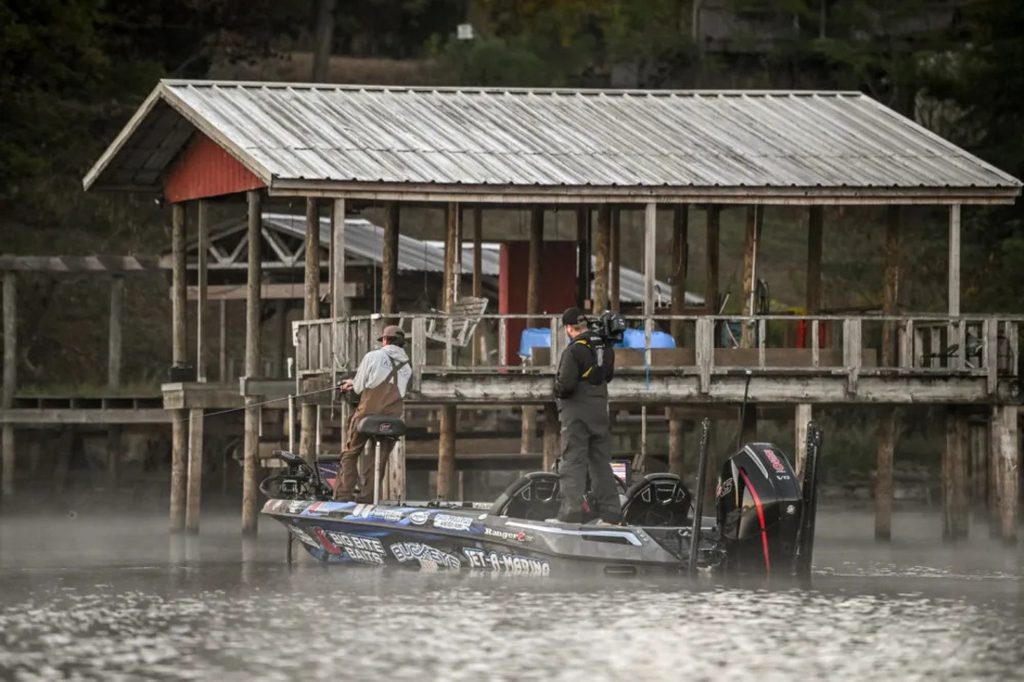
Furthermore, anglers should operate livewell pumps on continuous aeration throughout the competition day, adding non-iodized livewell conditioner salts to maintain natural slime coats and calm energetic fish. At the weigh-in line, using water-filled tournament mesh bags protects fins and ensures that trophy largemouth return safely to the fishery.
Discipline and Versatility on the Border Giant
Toledo Bend rewards anglers who approach its sprawling acreage with a flexible mindset and rigorous preparation. The competitors who consistently find the weigh-in stage on Big Toledo do not gamble on single spots or rigid techniques. Instead, they track the seasonal movement of baitfish, respect the navigational demands of the timber, and adjust their lure presentations as weather fronts alter fish positioning.
By pairing safe boat-lane navigation with a balanced game plan—combining shallow creek hunting with offshore sonar tracking—anglers can unlock the full potential of this legendary reservoir. Toledo Bend continues to be a crown jewel of Texas tournament bass fishing because it tests every skill an angler possesses, rewarding preparation and patience with world-class sport.