
Texas Fishing Tournaments are more than weekend scoreboards and weigh-in lines. Across the state, they function as sports events with measurable local spending, youth participation, charity support, and public access benefits. The strongest examples show how a tournament field can fill hotels, support marinas, bring families to parks, fund scholarships, and give towns a shared event calendar built around the water.
How Texas Fishing Tournaments Move Local Dollars
The clearest community-development case starts with tournament economics. Anglers travel, buy fuel, book lodging, eat locally, use boat ramps, purchase tackle, and spend time in host communities before and after weigh-in. That spending is not abstract. A 2024 study of large bass tournaments at Lake Fork Reservoir found that direct expenditures by anglers totaled $18.8 million annually for fishing trips in 2014–15. The same study found that six large tournaments held from July 2015 through June 2016 involved 7,923 anglers and generated $4.7 million in direct tournament-related spending, with an overall economic value of $5.7 million Lake Fork tournament study.
Those numbers matter because Lake Fork is also a competitive venue shaped by management rules. The study noted that this economic activity occurred despite restrictive slot-length fish size limits. From a sports standpoint, that shows how tournament demand can remain strong even when regulations require anglers to adapt their strategy, fish handling, and expectations at the scales.
Texas Fishing Tournaments As Sports Tourism
For Texas Fishing Tournaments, the sports-tourism model works best when the event gives traveling anglers a reason to stay in town and gives residents a reason to gather. The Bassmaster Classic in Fort Worth from March 21–23, 2025, offered a large-scale example. Texas Parks and Wildlife Department material reported that the event was only the fourth time the Classic had been held in Texas since 1971, drew an estimated 150,000 bass fishing enthusiasts, and produced an economic impact on local businesses of more than $25 million TPWD inland fisheries report.
That kind of event gives fishing the same civic profile that towns often associate with football tournaments, basketball showcases, or postseason runs. Readers interested in exploring how different sports communities connect beyond fishing can find valuable insights at NBA Playbook, illustrating that fishing creates its own community gatherings with boat checks, launch windows, weigh-ins, youth divisions, and conservation messaging tied directly to local waters.
Youth Access And Family Participation
Community development is not only measured in sales receipts. Fishing events also create entry points for children and families who may not otherwise join organized outdoor recreation. The Boerne Family Fishing Tournament, held at Boerne City Lake, is a free annual event on the first Saturday in June. The 2026 tournament took place on June 6, 2026, and was designed to introduce children to fishing, promote family outdoor activity, and provide a safe setting for participation.
That kind of structure lowers barriers. A family-friendly fishing event does not require a child to already own advanced gear or understand tournament culture. It gives new anglers a public setting, a clear schedule, and a shared activity with parents, grandparents, and neighbors. For smaller communities, that can be as valuable as the competition itself because it turns a lake or park into a common gathering point.
Youth competition also creates a path for development. Hook Spit Junior Anglers Association runs Redfish, Trout, and Flounder tournaments from Galveston to Corpus Christi for anglers ages 17 and under. The research notes show that the organization pledged more than $75,000 in scholarships, cash, and prizes in the preceding year. In a sport where experience is often passed down informally, youth divisions and scholarship incentives help young anglers see fishing as organized, goal-oriented, and connected to education.
Family Events Build The Next Field
A tournament field does not sustain itself unless new anglers enter the sport. The 2026 STAR Tournament, run by CCA Texas, began on May 23, 2026, at 6:00 a.m. Research notes list it as the state’s largest saltwater fishing tournament and credit the event with awarding more than $8.7 million in scholarships to youth anglers over its 36-year history, along with more than $40 million in prizes. Those figures show why youth programming belongs in the same conversation as weigh-in results. Scholarships make the event matter after the fish are measured.
Texas Sportsmen has also covered how local fishing events build community bonds, and the same pattern appears here: the strongest events connect competition with family access, local spending, and public participation.
Charity, Scholarships, And Shared Purpose
The charity side of tournament fishing is another direct link to community development. DHR Health’s Fishing for Hope Tournament in South Padre Island was held on August 22, 2026, as its 20th annual event. Research notes show that the previous year’s tournament raised more than $500,000 for Hope Family Health Center, which serves uninsured and low-income residents in the Rio Grande Valley.
That kind of event reframes the scoreboard. The heaviest fish, the cleanest run, and the most efficient day on the water still matter, but the event also carries a public-service outcome. Anglers, sponsors, volunteers, and families become part of a fundraising structure that connects competitive fishing to local healthcare access.
The Texas International Fishing Tournament in Port Isabel and South Padre Island is another example of a long-running event with community reach. The 86th tournament was held from July 29 through August 2, 2026. Before the event, research notes said it expected as many as 1,500 anglers and more than 500 boats, included a Kids 12 & Under Fish Free program, and planned to award 34 college scholarships in 2026. Since the event had already taken place by October 29, 2026, those details are best read as the documented event plan rather than a current attendance count.
Infrastructure And Access Beyond The Weigh-In
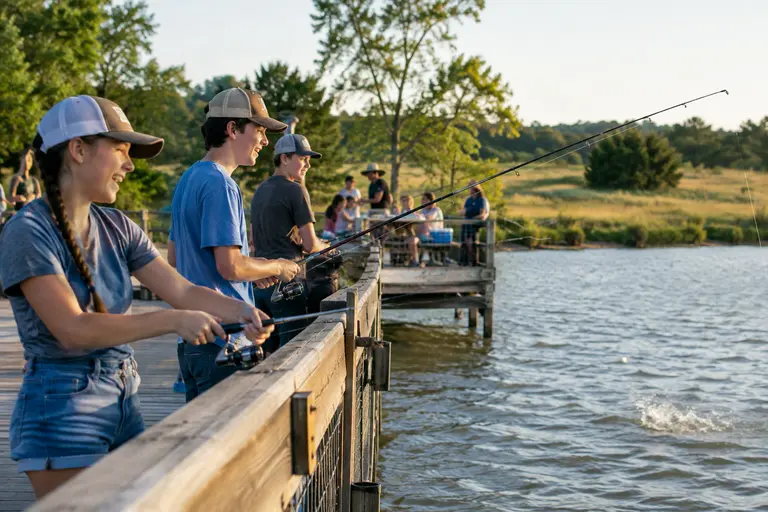
Fishing events also support community development when proceeds, partnerships, or related conservation efforts improve access to the water. Research notes describe a new ADA-accessible fishing dock installed at Galveston Island State Park on September 26, 2026. The dock was built by tradeswomen and funded through proceeds from a Gulf Coast conservation dinner, expanding access for families and anglers of all abilities.
Access projects like that change how communities use public water. A dock can help older anglers, children, wheelchair users, and new participants fish safely without needing a boat. For a state with major reservoirs, bays, parks, and coastal towns, infrastructure is part of the sport. Boat ramps, docks, shoreline access, parking, restrooms, and weigh-in space all affect whether an event feels open to the public or limited to experienced competitors.
That is why tournament planning and community planning overlap. A well-run event depends on roads, marinas, parks, volunteers, safety coordination, and public communication. In return, the event can make those assets more visible and, in some cases, help raise support for improvements.
Why Texas Fishing Tournaments Matter For Community Development
Texas Fishing Tournaments give Texas towns a sports platform that fits local identity. Lake communities can build around bass fields. Coastal communities can center redfish, trout, offshore, and family divisions. City parks can use smaller events to introduce children to fishing. Charity tournaments can turn a competitive day into funding for healthcare, scholarships, conservation, or public access.
The confirmed examples point in the same direction. Lake Fork showed measurable tournament spending. Fort Worth’s 2025 Bassmaster Classic showed the scale of fishing tourism. Boerne showed how a free youth-centered event can support family recreation. South Padre Island and Port Isabel showed how major saltwater tournaments can connect competition with scholarships and charity. Galveston showed how fishing and conservation fundraising can support physical access to the water.
The community value comes from the mix. A tournament is a sporting event first, but its reach extends through local businesses, youth programs, volunteer groups, public spaces, and families who gather around the weigh-in. That is why fishing remains one of Texas’ most practical forms of community sport: it uses local water, rewards skill, and gives towns a reason to come together.