
Lower Laguna Madre redfish fishing in July rewards anglers who can resist the urge to constantly run from spot to spot. In his July 2026 South Padre report, Capt. Ernest Cisneros described summer water temperatures rising into the low 90s, redfish using extremely shallow water early, and fish shifting toward deeper, cooler water as the day heats up. The pattern turns the Lower Laguna Madre into a daily timing exercise: find the right temperature, watch the mullet, understand the tide, and give productive water enough time before deciding the fish have disappeared.
Why July Makes Lower Laguna Madre Redfish Harder To Read
Summer redfish fishing on the Lower Laguna Madre can look deceptively simple. The bay offers broad flats, spoil-island shorelines, back bays, eastside sand, potholes, and deeper water along the Intracoastal Waterway. The challenge is that fish do not use all of those areas equally throughout a July day.
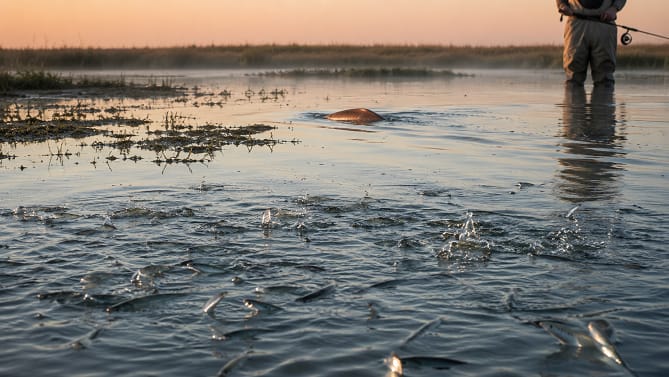
Capt. Ernest Cisneros wrote in the July 2026 South Padre fishing report that air temperatures commonly reach the high 90s and can exceed 100 degrees. He noted that summer bay-water temperatures normally rise into the low 90s and recalled seeing water reach 100 degrees during one extreme July.
That heat changes the fishing equation.
Redfish may be in ankle-deep or knee-deep water at sunrise, especially when wind is light and the flats have cooled overnight. A few hours later, those same fish can be using deeper potholes, channels, or ICW-adjacent flats where the water offers a more comfortable temperature.
The mistake is assuming that a productive morning shoreline should remain productive at noon.
Summer patience begins with accepting that the fish are moving according to conditions, not according to an angler’s schedule.
Why The First Hours Of Day Matter So Much
Cisneros specifically recommends trying shallow water early in July. Under calm conditions, anglers may see tailing redfish in extremely skinny water, and he warns against underestimating just how shallow those fish may go.
That creates one of the best sight-fishing windows of the summer.
A redfish pushing through a grass flat at sunrise has access to cooler water than it will have later in the day. Mullet, shrimp, small crabs, and other forage may also be active across those flats before heat and boat traffic increase.
Productive July areas cited in the report include spoil-island shorelines, deeper sections of back bays, and eastside sand.
But patience still matters even when those areas look empty.
Tailing fish may only show themselves occasionally. A school of mullet may need several minutes to reveal whether predators are traveling with it. A shoreline may appear lifeless until a tide begins moving.
An angler who immediately starts the motor after ten quiet minutes can leave just before the conditions improve.
Why Mullet Are One Of The Most Valuable Clues
One of the simplest pieces of July advice in Cisneros’ report may also be one of the most useful: large schools of mullet are common, and where there are mullet, redfish are often nearby.
That does not mean casting randomly into every mullet school.
The more useful approach is watching how the bait behaves. Are mullet calmly moving in one direction? Are they suddenly scattering? Are they concentrating along a depth change? Are small groups pushing across grass and sand transitions?
Redfish often reveal themselves through the behavior of prey before the fish become visible.
This is particularly valuable on the Lower Laguna Madre because the water can be clear enough for fish to become cautious. Repeated boat movement, aggressive trolling-motor use, or constant casting can work against an angler who has already found the correct area.
Once the bait looks right, slowing down can be more productive than searching for another location.
Texas anglers looking at the bigger coastal picture can also compare the Lower Laguna Madre with other top Texas redfish bays, but the Lower Laguna’s combination of shallow flats and clear water makes observation particularly important.
How Heat Pushes Redfish Toward Deeper Water
The July pattern changes as the sun climbs.
Cisneros reported that redfish move toward deeper, cooler water as the day heats up. He identified flats along the edges of the ICW and deeper potholes within flats as useful places to look.
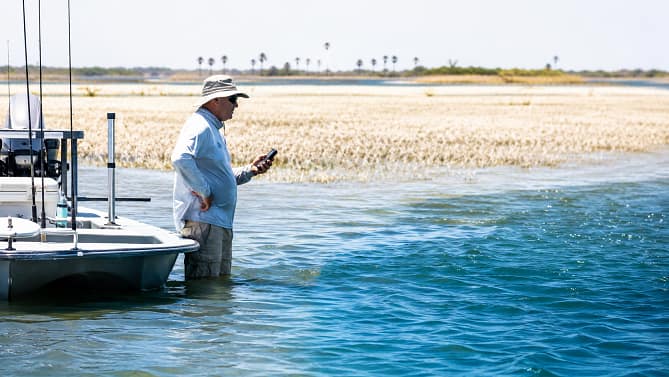
He also explained that during exceptionally hot summer conditions he prefers depths of roughly 3 to 4.5 feet while wading and may go deeper when drifting.
That is an important distinction for anglers who become too attached to shallow-water fishing.
The same redfish that were tailing over grass before breakfast do not have to abandon the general area completely. They may simply shift into the nearest deeper feature.
A pothole can become a temperature refuge. An ICW edge can provide both depth and moving water. A back-bay depression can hold fish after the exposed flat becomes uncomfortable.
Summer success therefore depends less on finding one permanent spot and more on understanding the connection between shallow and deep habitat.
What A Patient July Fishing Day Can Look Like
The Lower Laguna Madre rewards anglers who adjust gradually rather than making constant long runs.
| Time Window | Likely Redfish Zone | What To Watch |
|---|---|---|
| First Light | Very shallow grass, sand and shorelines | Tails, wakes, mullet and calm-water movement |
| Early Morning | Spoil-island edges and back-bay flats | Bait concentrations and moving tides |
| Late Morning | Deeper potholes and flat edges | Temperature changes and fish leaving skinny water |
| Midday | ICW-adjacent flats and deeper structure | Cooler water, bait and current |
| Late Afternoon | Transitional flats as water begins cooling | Returning bait and reduced boat traffic |
| Evening | Shallower feeding areas | Cooling water and renewed redfish movement |
This is not a fixed schedule. Wind, tides, clouds, water level, and boat traffic can change it.
The important idea is progression. Anglers should expect the productive depth to change and follow that change instead of repeatedly abandoning an entire area.
Why Water Temperature Deserves More Attention
Many coastal anglers watch wind and tide closely but treat water temperature as background information. Cisneros argues that it deserves more attention.
His July report recommends equipping a boat with a device capable of measuring water temperature, noting that the information is valuable during both the hottest and coldest parts of the year.
In July, even a small difference can help explain why one flat holds bait while another appears empty.
Deeper water generally warms more slowly than exposed shallow flats. A pothole only slightly deeper than the surrounding grass can become significant during the afternoon. Water exchanged through a deeper channel can also produce a different temperature profile.
The lesson is not that anglers need laboratory-grade measurements. It is that they should notice patterns.
If repeated bites occur at one temperature or depth, that information should influence the next drift.
Why July Tides Can Create Short Feeding Windows
Temperature is only part of the puzzle. Tide movement can determine when otherwise reluctant fish become active.
Cisneros highlighted the July 14 new moon and July 29 full moon in his 2026 report and wrote that stronger tides typically occur during the four or five days surrounding those lunar periods. His assessment identified 20 July days with favorable tidal flows.
The practical implication is that patience does not mean staying somewhere indefinitely.
It means understanding when a promising flat deserves more time.
A flat containing mullet, suitable depth, comfortable temperature, and structure may suddenly become productive when water begins moving. Leaving immediately before a tidal change can mean missing the most important feeding window of the day.
Conversely, staying for hours in hot, stagnant water without bait movement is not patience. It is simply refusing to adapt.
Good flats fishing requires knowing the difference.
Why Late Evening Can Rescue A Difficult Day
Summer fishing does not have to end when the morning bite disappears.
Cisneros specifically notes that late-evening redfish fishing can be excellent as the water begins cooling and boat traffic decreases.
That creates a second shallow-water opportunity.
Flats that were uncomfortable during the afternoon can become usable again. Bait may move back toward shallow areas. Reduced recreational traffic can also make clear-water redfish less pressured.
This is particularly useful for anglers who cannot launch before sunrise.
A carefully planned evening trip may offer many of the same advantages as an early-morning session: lower temperatures, softer light, less traffic, and renewed movement across shallow habitat.
The key is resisting the assumption that a slow midday report describes the entire day.
How Lure Choice Fits The Patience Strategy
Cisneros’ July recommendations include gold spoons along with Z-Man Scented PaddlerZ and DieZel KickerZ soft plastics.
Those lure types fit the Lower Laguna summer environment because they allow anglers to cover both shallow and transitional water without dramatically changing the entire setup.
A gold spoon can work efficiently over grass and across shallow flats. Soft plastics can be adjusted for different depths and retrieve speeds. When fish shift deeper, the same general bait profile can often be presented lower in the water column.
Presentation also matters.
When fish are pressured or heat has reduced their activity, repeatedly burning a lure through an area may produce fewer opportunities than slowing down and making more deliberate casts.
A patient angler is not necessarily fishing slowly every minute. The angler is giving the fish enough opportunity to reveal what presentation they want.
Why Constant Boat Movement Can Work Against Flats Anglers
The Lower Laguna Madre’s open water can tempt anglers to believe the answer is always somewhere else.
That mindset creates unnecessary running.
Every boat move costs fishing time. It also produces noise, increases fuel use, and can disturb shallow areas that might otherwise settle after a few minutes.
On clear flats, patience can mean using a drift, pole, or trolling motor carefully rather than repeatedly firing the outboard. It can mean making another pass through a productive area after adjusting the line slightly. It can mean waiting for mullet movement to reveal whether redfish are approaching.
This is especially important around shallow seagrass.
Anglers should avoid damaging sensitive bottom habitat while trying to chase fish into progressively shallower water. Good flats fishing depends on the same habitat that makes the fishery productive.
The goal is not to cover the maximum number of miles. It is to spend more time in water that has the right combination of depth, temperature, bait, and movement.
Why This Fishing Story Has Nothing To Do With Predicting Outcomes
Texas outdoor readers frequently overlap with the wider sports audience, which includes people who also follow commercial platforms such as MyBookie online sportsbook and casino. But Lower Laguna Madre redfish fishing works on a fundamentally different principle: there is no fixed outcome to predict and no substitute for observing real conditions on the water.
Wind changes. Bait moves. A flat warms. Boat traffic increases. A tide begins moving twenty minutes later than an angler expected.
Successful fishing comes from responding to those variables instead of trying to force an outcome.
That is another reason patience matters. The best information is often gathered while an angler is actually fishing.
How August Reinforced The July Lesson
The summer pattern did not disappear when July ended.
In his August 2026 report, Cisneros again emphasized elevated water temperatures and recommended concentrating redfish effort during the early morning and again in late afternoon or evening. He also described watching the direction mullet travel, noting where bites occur on repeated drifts, and using those observations to remain in the strike zone longer.
That reinforces the central lesson from July.
Summer Lower Laguna Madre fishing rewards pattern recognition more than random movement.
The angler who notices that fish are traveling in one direction, holding on a certain depth change, or appearing around one concentration of mullet can turn a few scattered clues into a repeatable pattern.
The angler who runs away after every quiet ten-minute period may never collect enough information to understand what is happening.
Why Red Drum Regulations Still Define A Successful Trip
Patience also applies once a redfish is caught.
Under current Texas red drum regulations, the daily bag is three red drum, with a minimum length of 20 inches and maximum length of 28 inches. TPWD also provides Red Drum Tag and Bonus Red Drum Tag provisions for retaining qualifying oversized fish during a license year.
Recreational anglers must have a Texas fishing license with a saltwater endorsement to land fish in state or federal water.
Those requirements matter on a summer flat because hurried fish handling can turn a good day into a bad one. Anglers should measure carefully, know whether they intend to harvest or release the fish, minimize unnecessary handling, and return released redfish efficiently.
The objective should not be simply accumulating bites.
A successful Lower Laguna Madre trip also means respecting the fish and the habitat that produced them.
What July Teaches About Lower Laguna Madre Flats Fishing
The July 2026 redfish pattern shows why patience is not passive.
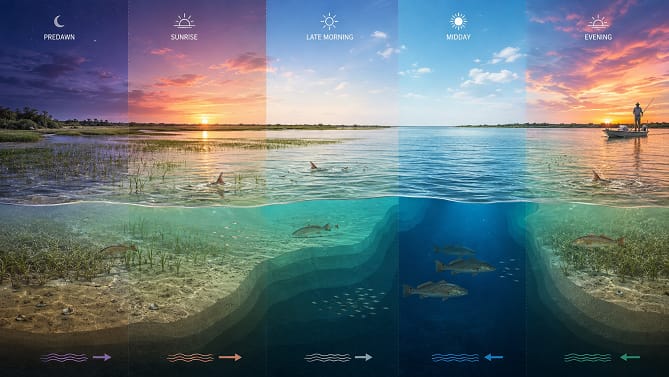
It means getting shallow before the heat builds. It means watching mullet longer than a few seconds. It means recognizing when fish have shifted toward 3- to 4.5-foot water or deeper potholes. It means giving a promising area time to improve as a tide begins moving.
It also means knowing when to leave.
If the water becomes too hot, bait disappears, and the tide goes slack, a depth change may be more valuable than another hour of casting the same shoreline.
The best summer flats anglers are constantly making small adjustments without turning every adjustment into a ten-mile boat run.
That approach fits the Lower Laguna Madre particularly well. The system gives redfish many ways to change depth without abandoning productive habitat completely.
July simply makes those transitions more obvious.
A tailing redfish at sunrise and a fish resting near an ICW edge at noon may be part of the same pattern. The angler who recognizes that connection has a better chance of staying with the fish.
And on the Lower Laguna Madre in summer, staying with the fish often requires patience more than speed.