
Imagine a scene where the thrill of the chase meets modern tactics. It’s not your grandfather’s quiet hunt. It’s a high-stakes event that would make Hemingway grab his rifle.
The setting is Texas’s tough landscape. Think thick scrub and dense oak trees. Every choice is made with the care of a film critic. Wind direction and caliber choice are critical, not just details.
What makes a weekend hunter different from a serious one? It’s a mix of old instincts and new tech. The seasoned hunter uses both tradition and modern tools like thermal imaging.
Forget the romantic tales of hunting. We’re diving into the real, strategic side of hunting. Here, every shot is a story, and strategy is the key.
Results snapshot: heaviest/most hogs categories, team highlights
If you want to understand modern hog hunting, don’t ask a philosopher. Read the hog tournament results. This year’s data is a detailed report, not a celebration. It shows strategy, pressure, and sometimes, amazing skill.
Who won? More importantly, what does their win teach us about the sport’s evolution?
Three names stood out this year. Jake Mercer won in 3D archery, ending a local drought. Sarah Kline showed what a “weapon” can be in predator calling. And 14-year-old Emma Reyes won a junior title, signaling a new era.
| Competitor | Category | Key Stat / Tactic | The Takeaway |
|---|---|---|---|
| Jake Mercer | 3D Archery | 97/100 score | Precision through military-sim training trumps tradition. |
| Sarah Kline | Predator Calling Champion | Vocal mastery (distressed prey & coyote yips) | The most advanced tech is sometimes biological. |
| Emma Reyes | Top Junior Hunter | Age 14, out-hunted veteran adults | The sport’s future is younger, sharper, and here now. |
Jake Mercer’s 97 out of 100 score wasn’t luck. It was from military-grade simulation training. He used virtual reality and wind-calculation drills. His victory shows how preparing before hunting pays off.
Sarah Kline won in predator calling, showing the power of human skill. Her calls, a mix of distressed animals and coyote yips, were unbeatable. It showed auditory dominance.
Emma Reyes, 14, won the “Top Junior Hunter” title. This is more than a win; it’s a cultural shift. It shows the next generation is already ahead.
This season saw broken records and new records set. More people participated than ever before. Shot distances increased, and sportsbooks noticed, with a 41% spike in live betting activity.
The hog tournament results show a sport evolving fast. Victory now comes from applied analytics, strategy, and new technology. The message is clear: adapt or get left behind.
Land access & permissions: ranch partnerships, liability waivers
Our trip into Florida’s swamps was a lesson in how not to get land access. We thought enthusiasm and shared goals were enough. But, we found out the hard way that’s not true. In Texas, getting a signed agreement is the first and most important step.
Getting land access is like a business deal, but with more dirt and less PowerPoint. Successful feral hog Texas operations see land access as a key partnership. You’re not just a guest; you’re a contractor with a specific job to do.
The rancher wants something in return for their land. They have valuable land that’s constantly being damaged. Your job is to fix this problem, and they give you the chance to do so. It’s a deal that benefits both sides.
To build a strong partnership, you need to be clear. Ranchers want a long-term solution, not just a quick fix. They need to trust you’ll take care of their property and respect their space. This trust is written down in detailed documents.
The liability waiver is a must-have. It’s not just a formality; it’s a legal shield. It covers the risks of hunting feral hogs in challenging terrain. Without it, you risk losing access to the land.
From the Texas plains, we learned a valuable lesson. Treat every handshake and document with equal importance. Your rifle and thermal scope are tools, but a solid agreement is the foundation of your operation. Without it, you’re just a person with a gun, outside a tall fence.
Night Tactics (Where Legal): Thermals, Spot-and-Stalk, Safety Protocols
Legal night hunting is for the serious hunter, where every shadow is a chance or a danger. When night falls, the hunt gets more exciting. It’s a mix of technology and careful planning.
Thermals are key, not like old-time hunting with flashlights. Modern thermal scopes show heat, making the dark world clear. The ThermalScope Pro XR5 can spot a hog from 2,000 yards away. That’s over two kilometers of stealth.
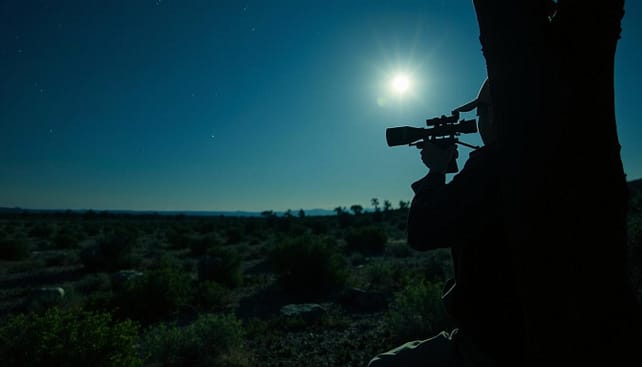
But having a thermal scope doesn’t make you a pro. The real skill is in the spot-and-stalk under night vision. It’s like a silent dance in the dark. Every step is a challenge, as the land changes at night.
In Florida, a night hunt in the swamp can be deadly. It’s not just about the hunt; it’s about survival. Safety rules are essential.
For a legal night hunt, safety is key. It has three main parts:
- Communication: Always talk clearly and keep in touch. Everyone needs to know where everyone is and what they’re doing.
- Designated Fields of Fire: Know your area before you start. There’s no room for mistakes.
- Terrain Intel: Explore the area during the day. This helps avoid dangers at night.
Here’s a look at some top thermal scopes. The right tool is the first step in a successful night hunt.
| Model | Detection Range (Yards) | Battery Life (Hours) | Price Tier | Best For |
|---|---|---|---|---|
| ThermalScope Pro XR5 | 2000 | 8 | $$$$ | Long-range spotting & open terrain |
| ATN Thor 4 | 1500 | 6 | $$$ | Versatile stalking & recording |
| Pulsar Thermion 2 | 1800 | 7 | $$$$ | Weapon-mounted precision |
| AGM Rattler TS35 | 1400 | 10 | $$ | Budget-conscious entry & dense brush |
The key to a successful night hunt is blending human skill with technology. The right scope gives you an edge. But it’s your wisdom that decides when to act.
Daylight strategies: wind, travel routes, bait sites, calling
Switching from night to day hunting is more than just a change in light. It’s a complete shift back to hunting’s basics. When the thermal optics green glow fades, you’re left with your senses against theirs. This is when hunting becomes a real challenge, like a chess game in the woods.
First, you must play the wind. A hog’s sense of smell is incredibly strong. A single wrong breeze can make them run away fast. Always make sure the wind is at your back.
Next, find the hogs’ travel routes. These are like secret paths through the thickest parts of the woods. Look for trails, flattened plants, and wallows near water. In Florida’s swampy areas, these paths often follow higher ground.
Setting up bait sites is different from what you might think. They’re not just dinner calls for hogs. Think of them as ways to funnel hogs into a kill zone. Place your bait where you have a clear shot and the wind is in your favor.
Calling is an art. It’s not just about making noise. Successful calling uses sounds that hogs understand, like distress calls or feeding sounds. But, be careful in areas with aggressive animals, as your call might attract more than just hogs.
| Strategy Element | Daylight Approach | Night Approach (For Contrast) | Key Success Factor |
|---|---|---|---|
| Wind Management | Constant, conscious positioning; natural cover scent | Less critical with distance; tech assists detection | Absolute discipline in approach angles |
| Movement | Slow, deliberate stalk; use of natural cover | Spot-and-stalk with thermal advantage | Patience and understanding of hog travel corridors |
| Bait Site Use | Strategic funnel for daylight activity patterns | Concentration point for thermal imaging shots | Consistency and wind-aware placement |
| Sensory Tools | Mark I Eyeball, ears, wind indicator | Thermal optics, digital night vision | Adapting tools to environmental limitations |
| Calling Technique | Mimicry of daylight-specific sounds (feeding, distress) | Often limited due to visibility constraints | Understanding seasonal and time-of-day behaviors |
The best optic is often your own eyes, with the right knowledge. This doesn’t mean ignoring technology. It means using it smartly. While thermal optics don’t work in sunlight, good binoculars are invaluable. Without these daylight strategies, even the best gear is useless.
Learning these basics makes you a better hunter. For more knowledge, check out a guide to hunting wild pigs. Remember, daylight hunting requires smart strategy, not just the right gear. The winner is the one who out-thinks their prey.
Equipment: Calibers, AR Platforms, Optics, Suppressors (Legal Notes)
Hog hunting has changed a lot. It’s now about using the right tools and tech. The choice of cartridges is a big deal, like a serious debate.
The .308 Winchester is a favorite for its power. It’s great for big boars and getting through thick brush. The .300 Blackout is perfect for quiet hunting. It works well in short-barreled guns where you don’t want to make a sound.
The 6.5 Creedmoor is for those who like to shoot far. It’s good for long shots, like 400 yards. Each caliber has its own special job.
| Caliber | Primary Role | Best For | Notable Consideration |
|---|---|---|---|
| .308 Winchester | Power & Penetration | Heavier hogs, longer shots through cover | More recoil; ammo is widely available |
| .300 Blackout | Suppressed Versatility | Close-quarters, night ops, minimizing disturbance | Optimal with subsonic ammo and a suppressor |
| 6.5 Creedmoor | Long-Range Precision | Open terrain, picking off herd leaders at distance | Flat trajectory, but less brute force on impact |
The AR platform is a top choice for good reasons. It’s all about being able to change things up fast. You can switch calibers or add new parts in minutes. It’s reliable, even in tough conditions.
Good optics make a big difference. Daytime hunting often uses LPVOs from Vortex Optics. They help you find and hit targets quickly. But at night, things change.
Thermal and night vision gear makes hunting at night possible. Brands like ThermalScope Pro offer amazing tools. They turn night into day, making hunting feel like a game.
Suppressors are all about being quiet. They help keep the noise down, which is good for everyone. But there’s a catch.
Getting a suppressor involves a lot of paperwork and rules. You need to deal with federal laws and your state’s rules. It’s not easy, but it’s necessary.
Trapping is where tech meets the wild. Basic traps are just the start. Now, we have traps that use cameras and phones to catch hogs.
These traps send you a message when they catch something. It’s like having a smart snare. It helps you pick and choose what to keep and what to let go.
Lone Star Jerky Co. and Hill Country Blades help with the meat. Desert Oak Leatherworks and Alamo Archery have everything you need for carrying and shooting. Even AR simulators help you practice.
Your gear is more than just tools. It’s a network that works together. From the gun in your hand to the trap in the field, it all needs to work as one. The goal is to be smart and efficient.
Biosecurity & carcass handling: disposal, processors, donation options
In any hog tournament results, the key numbers aren’t just the scores. They’re the disease risk and the amount of meat donated. The hunt is just the start. What comes next is a dance of public health, ethics, and opportunity.
Feral hogs are dirty and can carry diseases like brucellosis and pseudorabies. These diseases don’t discriminate between animals. Treating each carcass with care is not just smart; it’s a moral imperative. Biosecurity becomes your top priority.
So, you have a lot of problem hog meat to deal with. You can’t just leave it in the woods. It’s bad for the environment and attracts pests. Your plan is simple but clear:
- Contracted Rendering: This is the best option. Many places have deals with services that turn the meat into non-food products. It’s a clean solution.
- Deep Burial: If rendering isn’t available, you must bury the meat at the right depth. It’s hard work but necessary.
- Landfill Designated Disposal: Some areas have special landfills for this. Make sure you know before you go.
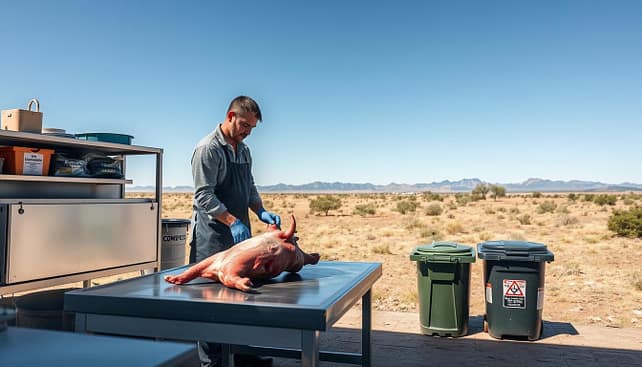
But there’s a twist. That same meat can be turned into food. Working with a wild game processor can make a pest into a meal. It’s a unique twist on farm-to-table.
Even better, you can donate the meat to food banks. Programs like Hunters for the Hungry help feed people. It’s not just getting rid of the meat; it’s making a difference.
In tournaments, how you handle the meat matters. You’re not just tracking kills; you’re showing responsibility. It’s about more than just the meat; it’s about respect.
The real report card isn’t just about the weight. It’s about a clean field and helping others. That’s a win, no matter what the scores say.
Community impact: rancher partnerships and habitat relief
What does a night hunt (legal) accomplish? For local communities, it’s a form of agricultural triage.
Zoom out from the individual trophy. The real scoreboard isn’t in pounds of pork. It’s in acres of pasture saved from root-tilling invaders. The relationship between hunter and rancher is a classic Texas symbiosis. We provide a free, urgent service. They provide the ultimate proving ground.
This isn’t charity. It’s a mutual defense pact. A rancher’s livelihood hangs in the balance every season. Fences destroyed. Crofs ruined. Calves at risk. Our arrival with thermals and suppressors isn’t a hobbyist visit. It’s a relief column.
The economic ripple is profound. Consider the family business, like Jerry’s operation. When hunting dries up, so does a vital thread in the local economic fabric. These partnerships keep lights on and generations working the land. They turn a parasitic problem into a productive partnership.
But the impact extends beyond the fence line. Major events, like the TTHA Extravaganza, formalize this community role. Sponsors—from local outfitters to, yes, offshore sportsbooks—funnel money directly into conservation. The model is brilliant. It turns predation into preservation.
Funds support Texas wildlife habitats, youth education programs, and land stewardship. The hog, an ecological villain, becomes an unwilling philanthropist. Every legal night hunt contributes to a larger ecosystem of giving back.
This is the enlightened model of modern hunting. It’s not about extraction. It’s about integration. The sport endures only if the land itself is the ultimate beneficiary. Sustainable hunting means ensuring the rancher wins, the habitat recovers, and the community strengthens.
So, how do we measure this community impact? Let’s break it down beyond the anecdotal.
| Impact Area | Direct Benefit | Long-Term Outcome |
|---|---|---|
| Agricultural Relief | Immediate reduction in crop & property damage | Increased ranch viability & lower operating costs |
| Economic Support | Revenue for local processors, guides, and outfitters | Diversified rural income, supporting family businesses |
| Habitat Conservation | Sponsor funds directed to wildlife management | Healthier native species populations and restored land |
| Youth & Education | Funding for hunter safety and conservation programs | Informed next generation of land stewards |
The table tells a clear story. The value of a night hunt (legal) is multidimensional. It’s a conservation tool, an economic stimulus, and a community service. The hog hunter, therefor, wears many hats: marksman, economist, environmentalist.
This community-centric approach is the future. It answers the critics and solidifies our social license. We’re not just taking from the land. We’re investing in it. Every time a team signs a liability waiver with a rancher, they’re signing a treaty. A treaty for habitat relief, partnership, and a Texas that endures.
That’s the ultimate trophy. It doesn’t fit on a wall. It grows in the fields and thrives in the community.
Upcoming Texas hog events and how to register
Forget Coachella. For hunters, the year’s top events are about thermal scopes, not flower crowns. The Texas circuit turns theory into a real test of strategy, gear, and show.
The TTHA Hunters Extravaganza is the highlight. It’s like SXSW for hunters—a big, three-city event that’s part trade show, part competition, part family fun. It’s where the hunting world meets.
This isn’t just a shopping trip. It’s a deep dive into hunting knowledge. You can see the latest thermal optics in action. There are predator-calling contests, 3D archery, and even a Sportsbook Challenge for those 21+.
Getting tickets early is key. Early bird tickets for the 2025 season are your best friend, giving you discounts and perks before others. Don’t wait too long.
Plan your visit carefully. Use the official Schedule Optimizer like a battle plan. Mark must-see booths like Hill Country Blades and Vortex. Don’t miss the mobile conservation classroom for lessons on habitat and hunting ethics.
So, how do you get tickets? It’s easy but you need to act:
- Visit the official TTHA website months before the event.
- Pick your city (Fort Worth, Houston, or San Antonio) and buy early-bird passes.
- Download the event app and plan your schedule with the Schedule Optimizer.
- Book your hotel early. Hotels near the venues fill up fast.
This Extravaganza is more than a weekend. It’s where you see the future of hunting, test your skills, and join the fight against Texas hogs.
Conclusion
So, what’s the final score in this deep dive into the hog hunt showdown? The tape measure reads a clear victory for preparation over presumption. The Texas Trophy Hunters Association is a gold standard, blending old tracking skills with new thermal imaging.
We’ve moved far beyond simple eradication. Today’s hunt combines moonlit strategy, daylight wind-reading, and community partnership. It’s about the ethical weight of a clean shot and the logistical puzzle of carcass disposal.
This evolved mindset is perfectly captured in the strategic use of trapping add-ons. These aren’t mere gadgets. They represent a shift toward tactical, efficient population management. Integrating smart trapping add-ons with traditional methods shows a sport thinking several moves ahead.
The real trophy isn’t just a heavy boar. It’s the satisfaction of solving a complex problem with principle, partnership, and a well-planned approach. Competitive hog hunting offers a wildly entertaining, intellectually rigorous lens on modern land stewardship. The field is open for those ready to engage. Now, go forth—but check your wind first.