
Fishing in Texas is a dream for many. Lakes like Fork and the Colorado River are known for huge largemouth bass. Success here isn’t just about skill—it’s about being well-prepared.
Top local guides know this well. They say the right gear cuts down stress and boosts your chances. A guide brings local knowledge right to your boat.
Competitive events here aim for bags over 25 pounds. You need to switch tactics fast. This means being ready for shallow fishing and using advanced electronics.
This list is your strategic edge. It combines expert local knowledge into a clear plan. For serious tournament anglers, this prep is key. It turns hope into a solid plan for success.
Boat & safety: PFDs, throw cushion, horn, flares where required, first‑aid, tool/prop kit
Before you start fishing, safety is key. A pro angler makes sure the boat is safe and ready. This is the same for a licensed fishing guide.
Your safety gear is like risk management tools. They help keep your day on the water smooth. A small problem shouldn’t ruin your fishing trip.
Let’s look at the must-haves for every boat.
Personal Flotation Devices (PFDs) are a must. The U.S. Coast Guard requires one for each person. Bass anglers like Type III PFDs for moving easily. Type V inflatables are comfy for long days.
A throwable flotation device is key for rescues. It’s fast help if someone falls in. Make sure it’s easy to reach.
Audible and Visual Distress Signals are needed on big waters. A loud air horn meets the sound rule. For visual, use approved flares or an orange flag. Check Texas laws for your fishing spot.
A well-stocked first-aid kit is for quick fixes. It has bandages, antiseptic, and tools for removing hooks. It’s not just for emergencies; it’s for helping yourself or your partner.
Lastly, a basic tool and prop kit is essential. It lets you fix small problems. A loose wire or a damaged propeller shouldn’t end your day.
| Essential Item | Primary Purpose | Key Features & Notes |
|---|---|---|
| USCG-Approved PFDs | Keep individuals afloat in an emergency. | Type III for fishing mobility; one per person. Inspect for wear annually. |
| Throwable Cushion | Provide flotation to a person in the water during a rescue. | Must be immediately accessible. Not a substitute for a wearable PFD. |
| Sound-Producing Device (Horn) | Signal for help and alert other boats. | Handheld air horns are reliable. Whistles attached to PFDs are a good backup. |
| Visual Distress Signals (Flares) | Signal for help during day or night. | Required on certain large lakes and coastal waters. Check expiration dates. |
| First-Aid Kit | Address minor injuries and medical issues on the water. | Include bandages, antiseptic, pain relievers, and hook-removal tools. |
| Tool & Propeller Kit | Perform minor mechanical repairs to avoid a tow. | Basic wrenches, screwdrivers, spare fuses, prop nut, and spare propeller. |
Your tool and prop kit is very important. A few tools can fix many problems. Don’t forget spare fuses and a spare propeller. A bent prop can be fixed quickly with the right repair tools.
This list isn’t just for rules. It’s about being a responsible angler. By having these critical tools, you can handle small problems. This keeps your focus on fishing.
Electronics & power: graphs, FFS, transducers, spare fuses, chargers, battery management
Life jackets and bilge pumps are just the start. The real game-changer is a top-notch set of graphs, sonar, and power systems. These tools turn vast waters into a detailed map of where to find fish.
James Caldemeyer, a pro angler, knows this well. He uses his Garmin LiveScope for targeting bass. This Forward-Facing Sonar (FFS) lets him see fish and structures ahead in real time.
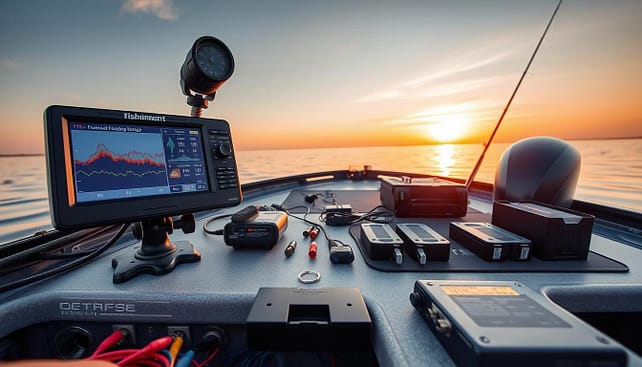
Your multi-function graph (MFG) is the heart of your operation. Make sure it’s paired with a well-mounted transducer for clear images. A bad installation can lead to lost signals and blurry views.
High-performance tools need strong power systems. A standard battery won’t cut it. You need deep-cycle AGM or Lithium batteries for your electronics. Lithium batteries last longer and are lighter, which is a big plus.
Managing your batteries is key. Always check the voltage. Use an onboard charger to keep all batteries at 100% before you start. Carry spare fuses for your units and power panels. A blown fuse can silence your most important tools at the worst time.
Here’s a simple power checklist for your boat:
- Dedicated Electronics Battery: Keep graphs and FFS separate from the starting motor.
- Voltage Monitor: Install a gauge to avoid deep discharge.
- Spare Fuses: Have a variety of amp ratings in your tools kit.
- Waterproof Connections: Use dielectric grease on all plugs and terminals.
Guides often highlight advanced electronics as a key benefit. They offer “electronics like fish finders and sonar” because they’re essential. For tournament anglers, it’s not just about the trip. It’s about being the guide and using the data from these tools to succeed.
Think of your power system as the heart and your graphs as the brain. They work together. A reliable setup keeps your digital eyes open from start to finish. Understanding this tech is key to doing well on Texas lakes.
Tackle core for Texas: heavy cover rods, frogs, big worms, lipless, Carolina rigs, flipping jigs, swim jigs, bladed jigs
A winning Texas bass tackle list isn’t just a bunch of baits. It’s a carefully chosen set for fishing in heavy cover and using different fishing styles. Your rod, reel, and line choices must work together well. They need to handle everything from thick hydrilla to deep underwater spots.
For fishing in thick vegetation, you need strong gear. A rod that’s heavy or extra-heavy, paired with 50-65 lb braided line, is essential. This setup gives you the power to pull fish out of their hiding spots. It also helps you set hooks quickly, which is important for techniques like:
- Hollow-Body Frogs: The top choice for fishing in slop and pads.
- Flipping Jigs: Like the Missile Baits Ike Mini Flip with a Berkley Powerbait Chigger Craw trailer. Use this to fish into stumps, laydowns, and grass edges.
- Big Sink Worms: Texas-rigged 10″+ worms for fishing in the thickest spots.
For fishing on the bottom, you need sensitivity and stealth. A medium-heavy rod with a fast tip and 12-20 lb fluorocarbon line is best. Fluorocarbon sinks and is almost invisible, making it perfect for:
- Carolina Rigs: A great bait for finding fish on offshore shell beds and points. The long leader lets it fall naturally.
- Texas-Rigs: The go-to bait for worms and creature baits.
- Swim Jigs: Fish these just above the grass line. The single hook avoids getting stuck, and the skirt gives great action.
To get reaction strikes from active fish, you need baits that move and flash. A composite rod with a moderate-fast action and 12-17 lb copolymer or fluorocarbon line is ideal. It offers the right balance for casting and control.
- Lipless Crankbaits: Burn them over grass flats or let them yo-yo on deep breaks. The Rapala DT6 in Caribbean Shad is a top choice for specific depths.
- Bladed Jigs (Chatterbaits): Great for covering water and fishing through scattered cover. Their violent vibration calls fish from afar.
- Squarebill Crankbaits: Deflect off wood and rock to trigger bites in shallow water.
This table shows the core system, linking each technique to the best gear for Texas fishing:
| Technique | Core Lure Examples | Recommended Line Choice |
|---|---|---|
| Heavy Cover/Punching | Frogs, Flipping Jigs, Big Worms | 50-65 lb Braid |
| Bottom Contact | Carolina Rig, Texas Rig, Swim Jig | 12-20 lb Fluorocarbon (e.g., Berkley Trilene 100%) |
| Moving Baits | Lipless Crankbait, Bladed Jig, Squarebill | 12-17 lb Copolymer or Fluorocarbon |
Mastering these line choices and pairings turns your Texas bass tackle list into a strategic tool. Each combo has a specific job, allowing you to adapt quickly to the day’s fishing conditions.
River/tide add‑ons: shallow cranks, spinnerbaits, tide clock app
When fishing in rivers and coastal lakes, you need special lures and knowledge. The water’s movement changes how bass behave. They often prefer fast-moving baits over slow ones.
In Texas, rivers like the lower Colorado and Guadalupe have rocky areas and lots of wood. A jet boat helps navigate these shallow spots safely. You’ll need lures that can handle the rough environment.
Shallow crankbaits are key. The Rapala DT series works well in these conditions, bouncing off obstacles and getting bass to strike. Spinnerbaits are also great. Their vibrating blades help fish find them in murky or moving water.
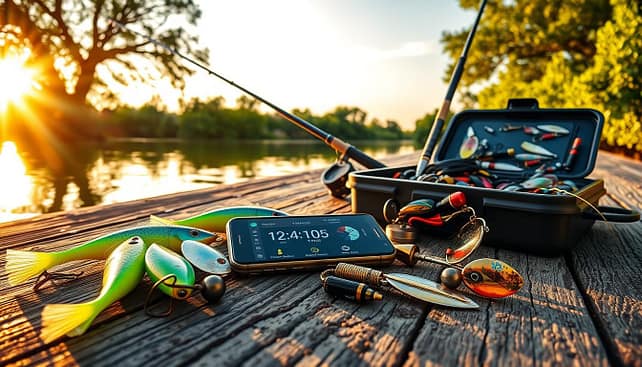
Choosing the right line choices is important. In clear rivers, use lighter fluorocarbon for a natural look. When the current slows, switch to lighter line choices for finesse fishing.
Coastal lakes and estuaries require understanding the tides. Bass move with the tides, so a tide clock app is essential. It helps plan your fishing for the best results. Learn more about tidal bass tactics for better fishing.
| Environment | Primary Lure Types | Recommended Line Choices | Key Consideration |
|---|---|---|---|
| River Systems | Shallow Crankbaits, Spinnerbaits, Jigs | 12-17 lb Fluorocarbon, 30-50 lb Braid (heavy cover) | Current speed and clarity dictate lure weight and retrieve. |
| Tidal Coastal Lakes | Swimbaits, ChatterBaits, Paddle-tail Grubs | 15-20 lb Fluorocarbon, 40-65 lb Braid (grass) | Fish the moving water; slack tide often shuts down feeding. |
| Clear River Finesse | Ned Rigs, Drop Shots, Small Jerkbaits | 8-12 lb Fluorocarbon, 10-15 lb Braid to Leader | Downsizing line and lures is critical in high-pressure or clear conditions. |
Success in these places comes from the right gear and timing. Carry a box with squarebills, spinnerbaits, and a tide app. This setup works from fast rivers to quiet tidal creeks.
Fish Care: The Livewell Life-Support System
Advanced livewell gear turns your boat into a mobile fish hospital. It ensures fish survive and meets tournament rules. Success is not just about the weight of fish caught. It’s also about the health of every bass released.
Proper care begins when a fish is caught. A stressed bass needs a stable place to recover. Your livewell is that critical safe place.
Tournament Compliance: Cull Tags and Scales
Accurate culling is essential. You must know which fish to swap out. A reliable cull tag system keeps your biggest bass identified and secure.
Use a certified digital scale to weigh fish quickly after catch. This gives you real-time data for strategy. It also reduces stress on the bass by minimizing handling time.
Modern fish care goes beyond just pumping in lake water. Pro anglers treat their livewells with additives that boost oxygen and reduce stress. Products like Please Release Me are popular. They help neutralize harmful ammonia and replenish essential slime coat.
Temperature management is also key. A sudden change can shock a fish. Match your livewell water temperature to the lake’s surface temperature. Use your boat’s timer function to cycle fresh water regularly. This maintains oxygen levels and removes waste.
| Livewell Additive | Primary Function | Key Benefit | Usage Tip |
|---|---|---|---|
| Oxygen Tablets | Boosts dissolved oxygen | Prevents suffocation in crowded wells | Add during long runs or hot days |
| Stress Coat | Replaces slime coat | Heals scales, prevents infection | Use after fish has been handled |
| Ammonia Neutralizer | Binds toxic ammonia | Cleans water, reduces gill burn | Essential for multi-day tournaments |
| Electrolyte Salts | Restores ion balance | Reduces osmotic stress | Follow package directions carefully |
A Critical Warning on Fizzing Tools
Fizzing, or venting, is a procedure to relieve swim bladder pressure in deep-caught fish. This is a medical intervention. It should only be performed by anglers who have received hands-on training from a certified expert.
Using a fizzing needle without proper knowledge can cause fatal injury. If you are not trained, the best practice is to not attempt it. Focus on superior livewell gear and temperature management instead. These methods often prevent the need for venting altogether.
Investing in proper fish care equipment makes you a steward of the fishery. It reflects the respect inherent in practicing catch-and-release for trophy bass. A healthy release ensures future generations can enjoy the same thrill. It also solidifies your reputation as a responsible and knowledgeable angler.
Printable load‑in/load‑out checklist
For Texas reservoirs and rivers, a detailed gear list is essential. A printable checklist helps avoid forgetting things in the dark. It makes getting ready a smooth, confident process.
Don’t forget your safety gear. Bring reliable rain gear for sudden storms. Also, pack sunscreen and UPF shirts to stay cool under the sun during long fishing hours.
Experts say wear clothes that match the weather and apply sunscreen. Adding these items ensures you’re ready for anything. This way, you can focus on fishing without worrying about your comfort.
Download our checklist to pack your Texas bass tackle. Check off each item, from sonar to Carolina rigs. It covers everything from boat safety to fish care tools.
Packing carefully clears your mind. Walk the dock feeling like a pro. Your thorough preparation is your best asset for tournament day.