
What makes a good angler great? It’s all about the mindset. Champion golfer Mike Booker says in his Tournament Golfer’s Playbook, there are two kinds of golfers. Those who play tournaments and those who are tournament golfers. The latter focuses on winning without drama.
Winning in bass fishing isn’t about luck. It’s about understanding the season’s patterns. Like a chess player, a tournament angler knows the texas seasonal patterns.
Success comes from mastering seasonal windows and water temperature. It starts with prespawn staging and continues with a clear plan. This way, there’s no room for excuses.
This guide is your playbook. It’s packed with actionable tactics for each season. We’ll show you how to turn chances into cash from spring to fall.
Seasonal windows and water temps
Think of water temperature as a master switch that controls bass behavior all year. Tournament pros say understanding this is key to winning. It’s not about knowing every fishing spot. It’s about knowing when and where bass move.
In Texas, the calendar is less important than water temperature. Certain temperatures trigger bass to move into predictable spots. This is like a chess player anticipating moves.
Let’s look at the key temperature zones for fishing strategy:
Low 50s (°F): The Prespawn Catalyst. When main lake temperatures hit the low 50s, bass start moving. They go from deep water to secondary points and creek bends. This is the prespawn staging period, where bass are active but not yet on beds.
Mid-60s: The Spawn Trigger. In shallow, protected bays, the spawn begins when temperatures reach the mid-60s. Bass move onto beds in these warmer areas. This is a time for sight-fishing, but knowing the rules is important.
Low 70s: The Post-Spawn & Summer Feed. After the spawn, bass are hungry and depleted. In the low 70s, they start a big feeding binge. They look for easy meals like bluegill beds and shade lines.
Thermocline Development: The Offshore Shift. When summer heat is steady, a thermocline forms. Bass suspend above this layer or find structures like ledges. This is deep fishing time.
Each temperature window means a change in bass behavior. Your job is to know which “position” the bass are in. Are they getting ready to spawn, or are they feeding aggressively?
This pattern-based approach makes fishing easier. You stop guessing and start interpreting. You learn when to strike based on water clues, not the month. With this knowledge, you’re ready to dive into specific tactics for each season.
Spring: prespawn staging points, sight‑fishing etiquette, wind lanes
The spring prespawn is more than just a transition. It’s a strategic game where bass position themselves on key underwater spots. These spots are where bass pause before moving to shallow flats to spawn. Finding these areas is your first key move.
Think of these spots as strategic squares on a game board. Controlling them gives you access to the most active fish. The three main zones are:
- Channel Swings: Where the main river or creek channel bends close to a flat. Bass use these as highways and holding areas.
- Secondary Points: The ends of smaller points that extend from the bank, often leading into a spawning cove.
- Ditch Mouths: The exit point where a drainage ditch or small creek meets the main lake. This is a major funnel for migrating fish.
These areas concentrate fish. They offer a mix of access to deep water and proximity to shallow spawning grounds. Your lure selection here should be versatile. A lipless crankbait, a jig, or a suspending jerkbait are excellent choices for probing these depths.

As the sun climbs and water clears, sight-fishing becomes a viable tactic. This requires immense stealth. The unspoken etiquette is key, even in tournaments. Never motor directly over a bed. Use your trolling motor on a low setting from a long distance. Polarized sunglasses are non-negotiable. If you see another angler working a bed, give them a wide berth. Winning here is about finesse, not intrusion.
Wind is often seen as a nuisance but is actually a predictable trigger. Use this simple “if-then” logic: if a strong, consistent wind is blowing directly into a spawning bay or flat, then baitfish and bass will be positioned along the wind-swept bank or points. The wind stacks plankton, which draws bait, which draws bass.
This is your tactical advantage. It’s like the chess principle where if your opponent’s queen leaves the back rank unprotected, you look for a back-rank tactic. The wind creates a clear pattern. Focus your efforts on these windward sides with reaction baits like spinnerbaits or chatterbaits. The choppy water provides cover, making bass less wary and more aggressive.
Always cross-reference your observations with current Texas freshwater fishing reports for water level and temperature trends. Mastering these spring elements—staging points, stealthy sight-fishing, and wind-driven patterns—sets a dominant foundation for the entire tournament season.
Shad spawn: early light zones, bladed jigs/spinnerbaits on hard edges
Mastering the shad spawn is like executing a blitz chess opening. It requires quick decisions and targeting the right zones before they close. This early-morning event is a high-speed tactical window where tournament games are won quickly.
The chaos begins at first light. Shad concentrate in specific areas known as early light zones. These are predictable locations where bass know breakfast is served.
Key early light zones include:
- Seawalls and concrete riprap
- Bridge pilings and dock supports
- Rocky banks and points
These structures absorb heat and attract baitfish as the sun rises. Your success depends on being there at the exact moment.
Speed is everything. As the chess saying goes, “Speed matters online. In blitz and bullet, a trap can decide a game before your opponent’s coffee cools.” Translate this to the water. You must make fast, precise casts to capitalize on the frenzy.
This is not a time for slow, methodical presentations. It’s a race to convert chaos into points.
The playbook emphasizes targeting hard edges during the shad spawn. Hard edges are distinct lines where solid structure meets the water. Think concrete, rock, or wood.
Soft edges, like grass lines or mud banks, are less effective here. Shad and bass relate tightly to the firm surfaces of hard edges at dawn.
Your primary weapons are bladed jigs and spinnerbaits. These lures excel for three reasons:
- They create intense vibration and flash that mimics fleeing shad.
- They can be burned just under the surface to cover water rapidly.
- They trigger reaction strikes from bass in an aggressive feeding mood.
Cast parallel to the hard edge. Retrieve your bait quickly, keeping it in the strike zone along the structure. Be ready for vicious, surface-busting strikes.
The entire shad spawn window may last only an hour or two after sunrise. Your goal is to identify the most productive early light zone and work it efficiently. Limit your pattern to these high-percentage areas.
Convert the morning’s brief chaos into a simple, repeatable plan. Find the hard edges at dawn. Throw moving baits with speed. Execute with precision. This approach turns a seemingly random feed into a tournament-winning tactic.
Post‑spawn/early summer: bluegill beds, shade and skipped jigs
Many anglers see the post-spawn period as a slump. But, a winning mindset views it as a predictable phase with clear patterns. Think of it like a drama-free tournament golfer who turns in a perfect score.
Post-spawn bass are tired and look for easy, high-protein meals. Bluegill beds are a prime target. Bass will ambush these fish, so focus on shallow, protected areas with visible vegetation or hard substrate.
Shade is also key. As the sun gets stronger, bass seek shade for comfort and ambush. Look for dock pylons, overhanging trees, boat houses, and the shadow line of a boat hull. These spots are high-percentage targets.
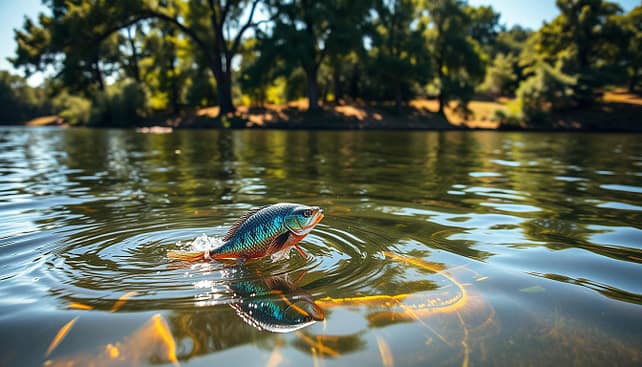
To reach these tight spots, you need to master skipping jigs. A compact jig with a stout hook, pitched underhand, can glide far back under cover. This technique allows you to place a bait silently in the strike zone of a recovering bass.
This inshore pattern will dominate until the summer thermocline starts to form. The summer thermocline is when warm surface water meets cold deep water. It pushes baitfish and bass toward specific offshore structures. Knowing when the summer thermocline starts to form signals the end of the post-spawn window.
So, work shade lines and bluegill beds with a skipped jig without excuses. When the action slows, it’s time to look deeper. This is your signal to move on to the next phase of the season.
Offshore summer: ledges, humps, shell beds; graphing routines; big worm/jig setups
The summer thermocline creates a unique underwater world. Bass gather on deep-water features like ledges, humps, and shell beds. This is because they seek cooler, oxygen-rich water. Your success now hinges on a well-planned strategy.
Think of it like a chess match. If the bass are on deep, cool structure, you need to present a large, slow-falling profile. This logic guides you. The mid-day grind is won by those who master this deep game.
Your main targets are offshore structure types: ledges, humps, and shell beds. Ledges are sudden depth changes, often along old river channels. Humps are underwater hills. Shell beds are hard bottom areas that attract baitfish. Bass use these as ambush points and comfort zones below the warm surface layer.
Finding them requires a disciplined graphing routine. Start by identifying the summer thermocline on your sonar. Look for a distinct, horizontal band where the water temperature changes rapidly. Bass will suspend just above or below this layer.
Next, scan main lake areas with your side-imaging and down-imaging. Follow this step-by-step search pattern:
- Map possible structure on your GPS at high speed.
- Circle back to promising spots and study them with detailed 2D sonar.
- Mark the exact top, edges, and bottom transitions of the structure.
- Note any baitfish schools or individual larger arches holding on the spot.
This graphing routine turns the lake bottom into your chessboard. You are not just fishing a spot. You are fishing a specific depth on a specific piece of that structure.
Your tackle must match the depth and precision required. This is the realm of heavy weights and big profiles. A classic Texas-rigged 10- to 12-inch worm is a prime choice. Pair it with a ¾- to 1-ounce bullet weight to punch through the thermocline and get to the bottom fast.
For jigs, a ½- to 1-ounce football or swimming jig is ideal. The key is the fall. A heavy jig gets down quickly and maintains contact with the bottom contour. It mimics a crawfish or bluegill seeking refuge in the deep cool water.
Your presentation should be methodical. Make a long cast past the target. Let your big worm or jig fall on a semi-tight line. Pay close attention to any tick or change in weight during the descent. Once it hits bottom, use slow, deliberate hops or drags. The bite in deep water is often a subtle pressure, not a violent strike.
This approach demands patience and confidence in your graphing. When others are lost under the summer sun, you have a clear plan. You are hunting the deep, cool sanctuaries where the biggest bass of the day are waiting.
Fall: bait migration; traps, squarebills, buzzbaits
Fall is a key time in bass fishing, known as the “pawn break.” This is when anglers get aggressive, using the fall chase pattern. Bass become more active, roaming freely. Anglers need to change their tactics quickly.
As water cools, baitfish start moving to shallower areas. Bass follow them. Finding these migrations is key to catching bass.
Look for diving birds and surface activity. Use your electronics to find bait balls. These are the signs of the fall chase.
Choose baits that act like a pawn break. Lipless crankbaits, squarebill crankbaits, and buzzbaits work well. They make bass react fast.
| Bait Type | Primary Scenario / Trigger | Retrieve & Presentation | Key Gear Consideration |
|---|---|---|---|
| Lipless Crankbait (Trap) | Bass chasing shad over grass flats or along submerged roadbeds. Excellent for “searching” large areas. | A steady, medium-speed reel with occasional sharp “rips” to make the bait deflect and flash. Let it fall on a semi-slack line after a rip. | Use a 7’3″ MH rod with a fast tip for solid hooksets. Braid-to-fluorocarbon leader provides sensitivity and abrasion resistance. |
| Squarebill Crankbait | Bass positioned near hard cover like rocks, wood, or dock pilings in 2-6 feet of water. | Cast parallel to cover and reel with a steady, relentless retrieve. The square bill deflects off obstacles, triggering explosive strikes. | A moderate-action cranking rod (7′ to 7’6″) protects treble hooks. 12-15 lb fluorocarbon offers the right balance of give and strength. |
| Buzzbait | Low-light conditions (dawn/dusk) or overcast days when bass are pushing bait to the surface. | Cast to visible activity or along shady banks. Retrieve just fast enough to keep the blade gurgling on the surface—no need to burn it. | A stout 7′ MH rod for driving hooks home on explosive surface strikes. Use a trailer hook to increase hook-up ratio on short strikes. |
For the fall chase, you need speed and reaction. It’s not about finesse. Keep rods ready for quick changes. This aggressive approach can lead to quick catches.
This active period is short. As water cools more, bass will change their behavior. Your goal is to match their aggressive nature with the right lures. Find the bait, and the fall chase will begin.
Cold fronts & winter drains: finesse + jerkbait lines
The Texas pattern playbook faces its ultimate test with plummeting barometers and water temperatures. Cold fronts shut down active fish. Bass seek deep, stable sanctuaries known as winter drains. These are the slow-moving creek channels and river arms where the entire population can congregate.
Your approach must shift to extreme precision. A finesse presentation is non-negotiable. Light fluorocarbon or braid-to-leader, paired with a small hair jig, Ned Rig, or drop shot, allows you to present a subtle, slow-moving target. A suspending jerkbait like a Megabass Vision 110 becomes a primary weapon. Work it with long pauses over channel edges and deep brush. The cadence is agonizingly slow.
This is where mentality defines results. As the quote from the Tournament Golfer mindset states, “Taking responsibility gives the player true freedom… own (the mistake), fix it, and eliminate it.” The recreational angler makes excuses about the tough weather. The tournament angler takes responsibility. They adapt their technique and mentality to grind out bites others miss.
Mastering the finesse and jerkbait strategy for cold fronts and winter drains completes your annual tactical cycle. It is the final chapter in a proven system. From spring prespawn sight-fishing to offshore summer ledges and fall shad migrations, you now possess a full-season playbook. This understanding of Texas bass behavior, from the first warm day to the last cold drain, is what transforms you into a consistent angler.