
Texas’ 2026 federal red snapper season opened earlier than many coastal anglers expected. The Texas Parks and Wildlife Department announced that the private recreational angler season in federal waters would open May 22 instead of the typical June 1 start, giving offshore crews a longer runway that includes Memorial Day weekend. For Texas coastal anglers, that date change affects more than the first legal snapper run. It changes how families plan summer trips, how boat owners watch weather windows, how marinas prepare for demand, and how anglers think about the line between state and federal waters before they leave the dock.
Why The May 22 Opening Changes The Summer Calendar
Red snapper planning in Texas usually begins before the first offshore run. Crews check fuel costs, boat condition, federal season timing, state-water options, weather forecasts, and whether they are fishing from a private vessel or through a federally permitted for-hire operation. The May 22 opening shifts that planning cycle forward.
TPWD’s federal red snapper season announcement made the change clear: the 2026 private recreational angler season in federal waters opened May 22 rather than the typical June 1 date. That gives private boat anglers access to federal waters before the traditional summer rhythm fully settles in.
That matters because Memorial Day weekend often acts as the practical beginning of Texas’ coastal summer. Families book lodging, crews plan offshore windows, marinas see heavier traffic, and boat ramps become more crowded. When red snapper enters that same window, the opening weekend becomes more than a regulation change. It becomes a scheduling signal for the entire coast.
For anglers in Galveston, Freeport, Matagorda, Port O’Connor, Rockport, Port Aransas, Corpus Christi, and South Padre Island, the earlier date gives more flexibility. A crew that cannot fish June 1 may still get a legal federal-water opportunity before school schedules, vacation travel, and summer heat reshape the calendar.
How State And Federal Waters Create Two Different Rulebooks
The May 22 opening matters because Texas red snapper rules are divided by water jurisdiction. TPWD explains that federal fishing jurisdiction begins at 9 nautical miles off the Texas coast, while red snapper inside the first 9 nautical miles is regulated by the state. That invisible boundary can change the season, bag limit, size limit, and planning strategy on the same offshore trip.
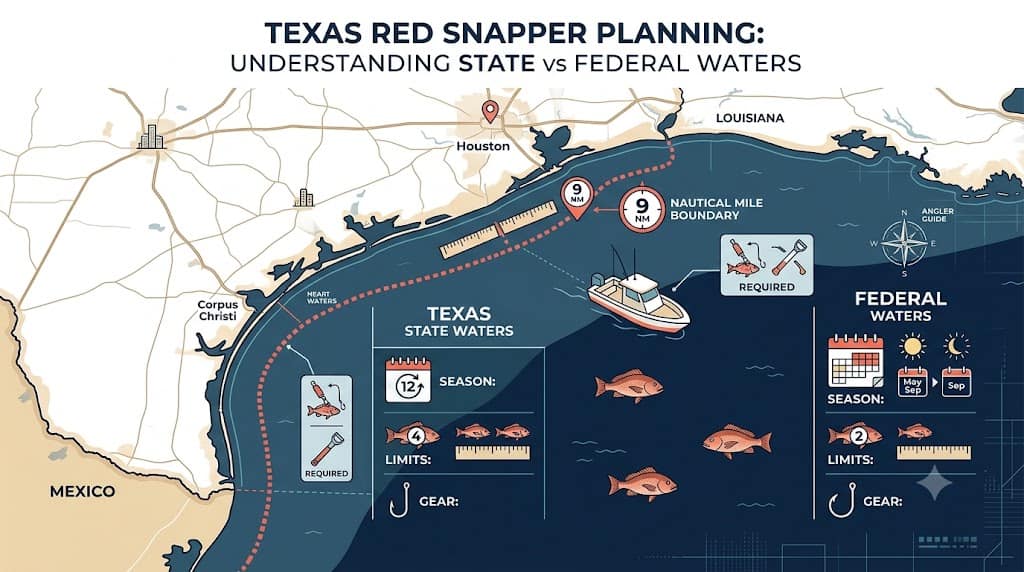
In federal waters off Texas, the 2026 private recreational red snapper season opened May 22. TPWD’s red snapper regulation page lists the federal private recreational limit as two fish per person daily with a 16-inch minimum size. The federal closure date is not fixed at the start; TPWD monitors in-season harvest to determine when the season closes.
State waters remain open year-round. The state-water rule allows four red snapper per person daily with a 15-inch minimum size. That difference is why anglers need to know where they are fishing, not just what species they are targeting.
| Fishing Area | 2026 Season Status | Daily Bag Limit | Minimum Size | Applies To |
|---|---|---|---|---|
| Texas Federal Waters | Opened May 22; closure monitored in-season | 2 red snapper | 16 inches | Private recreational anglers |
| Texas State Waters | Open year-round | 4 red snapper | 15 inches | Private recreational anglers |
The planning lesson is direct. A crew fishing inside state waters has different options from one running beyond 9 nautical miles. A captain who crosses that line without checking current rules risks turning a successful trip into a compliance problem.
Why Private Anglers And For-Hire Trips Are Not On The Same Clock
One of the easiest mistakes in red snapper coverage is treating every offshore trip the same. The May 22 Texas opening applies to private recreational anglers fishing from their own vessels in federal waters off Texas. Federally permitted for-hire reef fish vessels operate under a separate federal season.
NOAA Fisheries announced that the 2026 Gulf red snapper season for vessels with a federal for-hire reef fish permit opens at 12:01 a.m. local time on June 1 and closes at 12:01 a.m. local time on October 26. That is a 147-day federal for-hire season. The NOAA federal for-hire season bulletin gives charter customers and operators a separate planning calendar from the Texas private recreational opening.
That distinction affects families and occasional anglers. A private boat owner may see May 22 as the start of the federal-water opportunity. A customer booking a federally permitted charter must look at the June 1 for-hire opening. Both can be “red snapper season,” but they are not the same season.
For texassportsmen.com readers, the practical question is not just “Is red snapper open?” It is “Which type of trip are we taking, which waters are we fishing, and which rule set applies?” That is the kind of detail that separates good coastal planning from dockside confusion.
How The Earlier Date Pressures Boats, Ramps, And Weather Decisions
A May 22 opening gives anglers more days, but it does not guarantee more fishable days. Offshore fishing depends on sea state, wind, storms, fuel range, crew readiness, and whether a boat is prepared for a run beyond state waters. The earlier start creates opportunity, but it also puts more planning pressure on the first part of summer.
Boat owners may need to finish maintenance earlier. Batteries, electronics, safety gear, bilge pumps, trailer tires, fuel systems, and reef-fishing tackle all move up the checklist. The calendar gives anglers more time, but the Gulf still decides whether a weekend is safe and productive.
Ramp traffic can change as well. Memorial Day already brings more coastal movement. Adding federal-water red snapper to that window can put more pressure on popular access points. That affects departure times, parking, bait availability, fuel dock lines, ice supply, and the pace at cleaning tables.
The earlier opening also creates a different family-planning equation. A crew that normally waited until June may now plan a late-May trip, especially if school calendars, holiday travel, or lodging availability line up. That can spread some effort across more days, but it can also concentrate demand around the opening weekend.
This is where broader Texas redfish fishing strategy still matters. Coastal anglers rarely plan around one species alone. A trip that starts with red snapper may still include inshore backups, weather alternatives, or a family fishing day closer to shore if offshore conditions do not cooperate.
Why Reporting And Release Tools Matter More During A Longer Window
The longer Texas can manage federal-water access responsibly, the more valuable good angler behavior becomes. TPWD encourages anglers to log red snapper catches through the Texas Hunt & Fish app, formerly My Texas Hunt Harvest. The department says angler reporting supports successful fisheries management and helps track harvest during the season.

That reporting culture matters because the federal-water closure is monitored during the season. If harvest pace rises quickly, managers have to respond. If anglers report consistently and fish responsibly, the state has better information for managing the season around the quota.
TPWD also notes reef fish handling rules tied to barotrauma. Commercial and recreational anglers fishing in state waters are required to use a venting tool or rigged descending device for reef fish showing signs of barotrauma. Red snapper are commonly caught at depth, so release survival is part of responsible reef fishing even when a crew is keeping a legal limit.
Those details may sound technical, but they shape the sport. A red snapper trip is not complete just because fish hit the deck. Anglers need to know their limits, measure correctly, release unwanted fish properly, and report harvest when requested. A longer federal window only works if the fishing community treats data and fish handling as part of the trip.
How Coastal Businesses Could Feel The Earlier Opening
Red snapper season moves money along the Texas coast. Bait shops, fuel docks, marinas, tackle stores, ice suppliers, boat mechanics, restaurants, hotels, short-term rentals, and cleaning-table services can all feel the impact when offshore crews start moving earlier.
The May 22 date places federal-water access near the front edge of the summer travel cycle. That timing can matter for coastal communities that count on fishing traffic. A family heading to Port Aransas, a crew launching from Freeport, or anglers planning a run from Port O’Connor can turn one offshore trip into a full weekend of local spending.
There is also a staffing and inventory issue. Bait and tackle shops need to know when anglers will start asking for snapper gear. Marinas need fuel, ice, and ramp operations ready. Guides and charter operators have to explain the difference between private recreational openings and federal for-hire rules. Local restaurants and lodging operators may see the opening as one more reason families arrive earlier in the season.
For coastal towns, the date change is not just fisheries policy. It is a tourism and operations signal. The earlier the season opens, the earlier the summer fishing economy starts acting like summer.
What Texas Anglers Should Check Before Running Offshore
The best red snapper plan starts before the boat reaches the jetties. Anglers should confirm the current federal season status, understand whether they are fishing private recreational or for-hire rules, check the state-versus-federal boundary, review bag and size limits, and make sure everyone on board has the right license and saltwater endorsement.
Crews should also check weather windows with discipline. The May 22 opening gives more calendar space, but offshore conditions can still shut down a trip quickly. A good snapper plan includes safety gear, communication, fuel margin, reef-fishing tackle, release tools, ice, measuring equipment, and a backup plan if the run outside 9 nautical miles does not make sense.
The strongest anglers treat regulations as part of the sport, not an obstacle around it. Texas has a year-round state-water opportunity and a monitored federal-water season. Knowing how those pieces fit together lets anglers fish with more confidence and fewer surprises.
Why The May 22 Opening Matters Beyond Opening Weekend
The May 22 federal red snapper opening gives Texas private recreational anglers an earlier start, but the bigger story is how it changes the shape of the summer. The season now reaches into Memorial Day planning, affects the timing of boat preparation, pushes anglers to understand the 9-nautical-mile boundary, and gives coastal businesses a clearer reason to prepare before June.
For experienced crews, the extra days may create more room to wait for the right sea state instead of forcing a risky or rushed trip. For families, the earlier date can open a practical holiday window. For fisheries managers, the season still depends on harvest monitoring, responsible reporting, and reef fish handling.
That is why the 2026 red snapper opening deserves attention across the Texas coast. It is not just an earlier date on a calendar. It is a planning shift for anglers, marinas, families, and coastal communities that measure summer by the first safe run offshore.