
Let’s get something straight. Watching a fishing competition isn’t just about waiting for something to happen. It’s not like watching wood pushers play chess.
Being a top bass fishing spectator is actually a smart game. It’s about watching a silent battle in a huge lake. The players use sonar and tiny lure changes to communicate.
You’re like a sideline expert. Your task is to understand their plans as they happen. It’s all about reading the water and guessing their next move.
This guide will turn you from a casual fan into a keen observer. You’ll learn to predict what’s coming next at the 2025 Bassmaster Classic at Lake Ray Roberts. It’s your chance to become a pro at reading the water.
It’s time to go beyond just being a fan. You’re about to become a true expert at watching the action. This is your journey to becoming an informed spectator.
Understanding Tournament Formats
Watching random fishing is different from mastering tournament viewing. You need to understand the competitive structure. It’s like watching a quarterback without knowing what a touchdown is.
These events are not just fishing trips. They are long, multi-stage competitions where consistency is key. Anglers fish for three days, with their five heaviest bass each day adding to a total.
Winning at places like Ray Roberts requires a huge total of 60 to 70 pounds. It’s not just luck. It’s a well-planned attack on the fish’s habitat.
The official rulebook is strict. It covers everything from start times to how to handle fish. The Texas B.A.S.S. Nation rules clearly state penalties for breaking the rules. Knowing this makes the event more understandable.
Watching a tournament is more than just seeing a cast. It’s about a fisherman’s strategy against unpredictable fish. They must also manage their time and points. It’s like “Moneyball” on the water, not just “Gone Fishin'”.
Here’s what makes a good spectator:
- The Cumulative Mindset: Daily weights are important, but the total over three days decides the winner. A bad Day 1 doesn’t mean you’re out.
- The Rulebook Reality: Breaking rules, like being late or having dead fish, can change the leaderboard. The drama is not just in the catch.
- The Hidden Strategy: Anglers often save their best spots for later. What looks good on Day 1 might be a trick.
This knowledge turns your tournament viewing from passive to active. You start to guess what will happen next. You become part of the story.
Best Spectator Locations
Attending a major Texas bass tournament offers two main experiences. You can choose to watch from a calm, wide view or get up close to the action. Your choice affects your whole day. Let’s explore the different options.
Watching from the shore lets you see the whole field. Look for public parks, fishing piers, and spots near the launch site. These are the “50-yard line” spots. You’ll get a wide view of the tournament’s start.
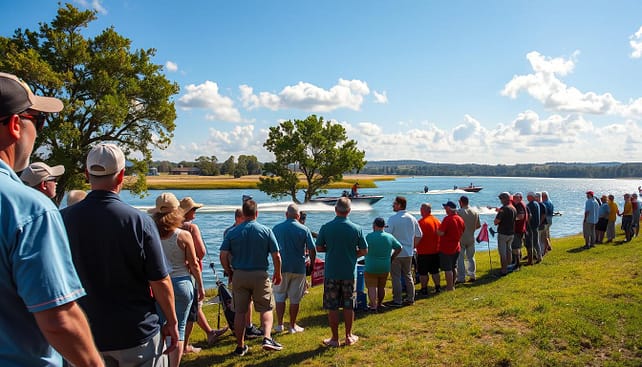
The real action is in the side tournaments. For example, the Progressive Celebrity Pro-Am at Eagle Mountain Lake on March 19. It’s a high-energy event with top anglers and celebrities. The vibe is different, and the action is intense.
So, what’s your preference? Do you want a broad view or a close-up look? To find the best spot, check out an ultimate guide to attending the Bassmaster. The table below highlights the main differences to help you choose.
| Viewing Platform | Vibe & Experience | Best For | Prime Example (2025) |
|---|---|---|---|
| Land (Shore) | Strategic, panoramic, relaxed. You see the “big picture” launch and return. Crowds can be spread out. | The analyst, the photographer, families, those who prefer stable ground and plenty of personal space. | Lake Ray Roberts public access points & parks. The classic Texas bass tournament spectator experience. |
| Ancillary Event | Intimate, chaotic, high-energy. Concentrated action with pros and celebrities. More interactive. | The superfan seeking unique access, those who love a party atmosphere, and celebrity spotters. | Progressive Celebrity Pro-Am at Eagle Mountain Lake (March 19). A focused, star-powered preview. |
| On-Water (Private Boat) | Immersive, tactical, unpredictable. You follow the action but must respect strict no-wake and distance rules. | The seasoned boater, the hardcore angler wanting to study techniques up close, adventure seekers. | Following competitor boats on Ray Roberts (with extreme caution). Not for the faint of heart or inexperienced. |
Your spot is your view. From the shore, you see a grand show. At the Pro-Am, you feel the excitement. Each offers a unique way to see the skill and drama of top bass fishing. Choose your spot carefully.
Daily Schedule & Timing
Forget lazy weekends. The Bassmaster Classic demands a spectator schedule more rigorous than a film critic’s at Sundance. You’re not just attending an event; you’re syncing with a tournament’s circadian rhythm. Master this, and you transition from a passive observer to an analyst in the field.
Classic Week is a crescendo. It doesn’t start with the main event. The overture is the Progressive Celebrity Pro-Am on Wednesday, March 19th. Your day begins at Eagle Mountain Lake. Be there by 7:15 a.m. to absorb the pre-launch buzz—the quiet intensity is palpable. The official takeoff is at 7:30 a.m.
Your midday move? The Expo opens at 12:30 p.m. at the same location. But the real drama returns at 1:30 p.m. for the weigh-in. This Wednesday showcase is your warm-up act, a chance to calibrate your spectator instincts before the headliners take the stage.
Thursday, March 20th, offers something unprecedented: a backstage pass. The Bassmaster Classic Media Day runs from 1-3 p.m. at Bass Pro Shops in Grapevine. This is where the pros face the press. As a fan, you get a front-row seat to the pre-game mental chess. Listen to their strategies, their concerns. It’s a unique layer of access for the dedicated bass fishing spectator.
Then, the main event. The Classic itself typically runs Friday through Sunday in early March. Each day has a sacred routine for the savvy viewer.
The Morning Launch (~7 a.m.) is for tension. This isn’t about seeing fish. It’s about witnessing the moment of commitment. Sixty boats idling, then roaring off—each angler married to a plan. You feel the tournament’s energy snap into kinetic.
Midday is for strategy and scouting. The anglers are out on the water. Your job? Hit the massive Bassmaster Expo. Analyze gear, or simply grab lunch. This is your research period. Check social media for unofficial updates—the modern spectator’s telegraph.
The Afternoon Weigh-in (~3 p.m.) is for pure drama. This is the climax of each day’s narrative. The bag weigh-ins, the reactions, the leaderboard shifts. It’s where hopes are realized or sunk. Your daily itinerary must block this time. It’s non-negotiable.
So, craft your plan like a military campaign. Block out times. The early bird doesn’t get the worm here; they get the atmosphere. The disciplined bass fishing spectator who respects the schedule is the one who experiences the full, unfiltered story of the Classic. Anything less, and you’re just watching a fishing show with really good surround sound.
Boat Launch Viewing
If you think tournament viewing starts with the weigh-in, you’ve missed the beginning. The launch is the start, the first pitch, the moment the show begins. It’s a scene of controlled chaos that deserves your full attention.
This is where the day’s story is set before a single lure hits the water.
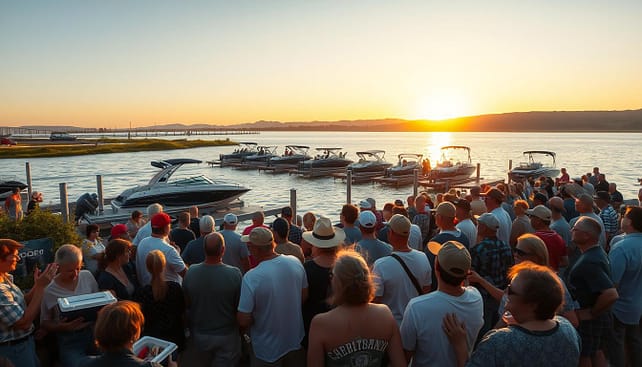
The first rule of launch tournament viewing is simple: arrive early. The pre-dawn atmosphere is unique. It’s a mix of quiet focus and roaring chaos, each telling a part of the story.
| Energy Type | Manifestation | What It Reveals |
|---|---|---|
| Quiet Focus | Anglers staring at maps, rigging rods in silence, running mental simulations. | The intellectual and strategic core of the sport. This is the chess match before the physical game. |
| Roaring Chaos | Engines firing, last-minute gear checks, the organized scramble to the water. | The raw, physical spectacle and adrenaline. This is the thunder of hooves at the Kentucky Derby. |
Watch the anglers closely. Some perform a meticulous ballet with their rods, a study in obsessive preparation. Others stand motionless, gazing at the water like generals surveying a battlefield. This is also where you witness the sport’s physicality. Loading a boat is an athletic feat in itself.
Then comes the moment. At safe-light, the first flight gets the signal. It’s not merely a departure. It’s the starting gun for a high-speed, high-stakes scavenger hunt across the lake. The sound of a dozen high-horsepower outboards roaring to life in unison is a visceral experience. It’s the bass fishing equivalent of a rocket launch.
That sound alone justifies the early alarm clock. It’s the universal signal that the show has officially begun. For the savvy spectator, understanding this drama transforms passive tournament viewing into an immersive experience. You’re not just watching boats leave. You’re witnessing the launch of hopes, strategies, and a full day of silent combat you’ll only hear the results of later.
Weigh-in Ceremony Guide
The weigh-in ceremony is where secrets on the water turn into headlines. It’s like the final scene of a play, where every detail matters. If you’ve been watching all day, this is where you find out what really happened.
This isn’t just a fish show-and-tell. It’s a mix of sport and theater. It’s the most exciting time to watch together. The air is as thick as Texas humidity in July.
Your first task is to get a seat early. The best spots fill up quickly. As anglers arrive with their bags, the crowd gets quiet. Everyone waits for the moment of truth.
Don’t just watch the scale. The emcee’s interview is key. When a pro talks about their big catch, it’s not small talk. It’s a lesson in fishing strategies. Listen carefully, like an expert.
Then, watch the crowd’s reaction. A big catch doesn’t just change a number. It’s a big deal. Cheers and groans fill the air. The leaderboard updates like a stock ticker. One big fish can change everything.
To enjoy this drama, here’s what to expect and how to make the most of it:
| Stage of the Weigh-in | What’s Happening | Pro Spectator Move |
|---|---|---|
| The Walk-Up | Anglers bring their bags to the stage. Body language says everything. A confident stride? A weary look? The bag’s bulge hints at the story inside. | Scan the anglers. The ones with the steadiest gaze often have the steadiest hands—and the best catches. |
| The Interview | The emcee asks about the day’s key catch, pattern, or challenge. This is pure strategy disclosure. | Take mental notes. Jot down bait names and conditions. This is free, expert-level fishing intelligence. |
| The Weigh-Master’s Call | The official calls out the weight. “FIVE pounds, THREE ounces!” The number flashes on the big screen. | Watch the leaderboard instantly. See where that weight slots in. Does it create a new leader? Does it bump someone out of the cut? |
| The Leaderboard Shuffle | With each new weight, the standings dynamically update. This is the live, ticking drama our sources describe. | Follow one or two anglers you saw earlier. Track their rise or fall. It personalizes the statistical battle. |
Timing is key. While big Texas bass tournaments might have late afternoon weigh-ins, local events stick to a schedule. Don’t miss the winner’s moment. For a typical event, aim to be in your seat by 1:15 p.m. for a 1:30 p.m. start.
The weigh-in turns a day of fishing into a shared event. It’s where respect is earned, legends are made, and you get to see all the drama. Stay until the end. The best stories are often the last ones.
Meeting Professional Anglers
Meeting tournament pros is like watching animals in their natural habitat. It’s not about getting autographs. It’s about learning from them. Bass fishing is quiet and timing is key.
As a bass fishing spectator, you’re not there for signatures. You’re there to learn. These athletes are like craftsmen getting ready for a big fight. You should approach them with respect.
The Bassmaster Classic Media Day on March 20 at Bass Pro Shops in Grapevine is a game-changer. It’s a rare chance to see all the competitors up close.
This event is like spring training for bass fishing. You’ll see how they prepare their gear and listen to their interviews. It’s a unique chance for the average bass fishing spectator.
But what about other times? Timing is everything. Here’s how to approach them:
| Opportunity | Timing | Pros | Cons | Best Approach |
|---|---|---|---|---|
| Media Day | March 20, Pre-tournament | All anglers present, relaxed atmosphere, gear viewing | Can be crowded, limited one-on-one time | Observe first, ask specific questions later |
| After Weigh-in | Once press obligations are complete | Anglers are decompressing, more reflective | They’re tired, may want privacy | Brief, congratulatory comment with one technical question |
| Expo Booths | Scheduled appearances | They’re literally paid to engage, structured time | Can feel transactional, lines can be long | Have your question ready, be efficient |
| Other Venues | Unexpected encounters | Authentic, spontaneous interaction | Risk of interrupting private time | Read body language, keep it very brief |
Be like a thoughtful journalist, not a star-struck fan. Asking for a picture is like asking a chef for a selfie while they’re cooking a Michelin-star dish.
Instead, ask specific questions about what you saw. “I saw you targeting docks with a pitching presentation today—were you focusing on a particular depth or cover type?”
This shows you’re an engaged bass fishing spectator. It also gives the angler something interesting to talk about.
Remember, these pros are at work. The Expo booth is their office. The weigh-in stage is their boardroom. Your presence as a knowledgeable bass fishing spectator helps the sport.
The new Media Day format is a big change. It gives fans access, not just a view. It turns the bass fishing spectator into an embedded journalist.
So, bring your curiosity, not just your camera. Ask about wind adjustments, lure selections, or pattern changes. You’ll get more than a photo. You’ll have a real conversation with a top athlete.
The goal for any serious bass fishing spectator is to learn more than just memories. It’s to gain understanding.
Photography Etiquette
The rule of tournament viewing is simple: observe, don’t intrude. In today’s world, we all act like documentarians. But at a bass tournament, it’s key to capture the story without being a paparazzo. Your goal is to show the focus, strategy, and emotion from afar.
Imagine the space around a competitor’s boat as a bubble of focus. Your aim is to respect that space, not break it. A good zoom lens helps you capture the intensity in an angler’s eyes from far away. You see the careful looks at the sonar and the small movements of their hands. You become a silent witness.
Sound is as important as sight. The sounds of the sport, like the flip of a bail, are what make it special. But, the camera’s shutter sound or a phone’s fake shutter? That’s just noise. Silence it. This small act shows you respect the event.
Drones are a no-go. They’re banned because they’re seen as unfair and a distraction. A drone is more than a camera; it’s an invasion of privacy. So, keep your feet on the ground and your camera in your hands.
The best photo from a day of tournament viewing won’t be a close-up of a fish. It will be a wider shot that shows the angler in their natural setting. It tells the story of the angler against the Texas landscape. You’re there to add to the respect, not disrupt the competition.
Weather Preparation
Watching Texas bass tournaments is like a battle against the weather. March in North Texas is unpredictable. You might see all four seasons in one day, with cold fronts arriving unexpectedly.
Your gear is your shield. Wear layers: a base that wicks moisture, an insulating middle layer, and a waterproof outer shell. Choose waterproof boots with good grip for wet banks. Don’t forget sunscreen and a hat to protect against the Texas sun.
Always carry an umbrella or a compact poncho. It’s not just for comfort. It’s about staying in the action. Leaving for your car means missing the excitement.
When a cold front hits, fish change their behavior. Anglers quickly adjust their tactics. Seeing this adaptation is the best part for spectators. Being prepared lets you fully enjoy the event.
Going to these tournaments means facing the weather head-on. Wind, rain, and sudden sun are all part of the show. Being ready turns you from a bystander to an active observer of the sport.
Pack wisely. Dress with purpose. The most memorable moments often happen when the weather is tough. Be there to witness them.