
The structural integrity of the Texas coast is undergoing a quiet, well-funded transformation that has very little to do with legislative gridlock and everything to do with private capital. For decades, standard fisheries management focused on bag limits, length restrictions, and seasonal closures to keep redfish populations healthy. While those regulatory levers remain vital, the conversation on the water has shifted toward a more foundational reality: you cannot have a world-class inshore fishery without world-class benthic habitat. Across the Texas bay complexes, from the sprawling flats of Galveston down to the hypersaline waters of the Laguna Madre, oyster reefs serve as the biological engines that drive redfish productivity.
As the 2026 spring tournament season intensifies, the intersection of private philanthropy and habitat restoration has emerged as the most critical storyline for coastal anglers. Millions of dollars in private donations are currently bypassing bureaucratic inertia to directly rebuild the state’s degraded oyster infrastructure. For the everyday wade fisherman or the professional redfish team tracking slot fish on the flats, this infusion of private cash isn’t just an environmental talking point—it is a direct investment in the structural relief, forage abundance, and water clarity required to sustain the current coastal fishing boom.
The Public-Private Surge: Supercharging the Oyster License Buyback Program
The most immediate and structural impact of this private funding is visible in the rapid acceleration of the Texas Parks and Wildlife Department (TPWD) Oyster Boat License Buyback Program. Historically operating under a slow-moving reverse-bid system, the program struggled to compete with large commercial oyster operators who were aggressively buying up permits to maintain high-intensity dredging operations on public reefs. The breakthrough came when conservationists and state officials pivoted to a straightforward, public-private fixed-price model.
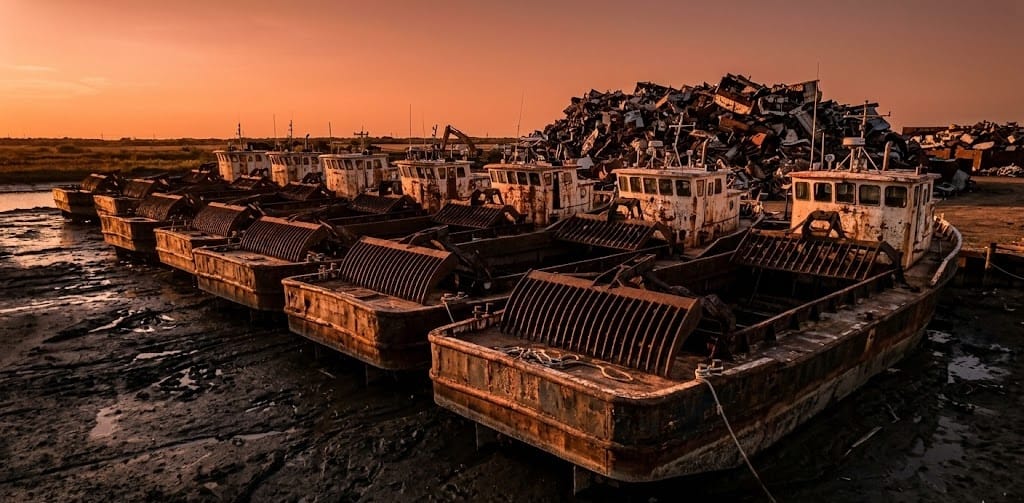
During the application window that closed on May 15, 2026, commercial oyster boat license holders were offered a flat rate of $30,000 to permanently retire their permits. This aggressive, flat-rate incentive was made possible because private donations matched state resources dollar-for-dollar. A monumental $1 million anchor gift from the Coastal Conservation Association Texas (CCA Texas), funneled through the Texas Parks and Wildlife Foundation (TPWF) via the S. Reed Morian Oyster Buyback Program, completely altered the landscape. This massive philanthropic push, heavily supported by influential Texas families, enabled the state to pull 112 commercial dredging vessels off the water in a single year—effectively shrinking the Texas commercial oyster fleet by more than 20 percent.
By removing one-fifth of the commercial dredging pressure from public waters, these private dollars have granted fragile reef systems an unprecedented window for vertical recovery. For redfish anglers, fewer active dredges mean less acoustic disruption on the bays, zero siltation clouds suffocating adjacent seagrass beds, and the preservation of pristine shell structures where post-spawn reds gather to feed.
The 250 Million Dollar Vision: Pulling Bays Back From the Tipping Point
While buying back commercial licenses curtails active habitat destruction, reversing decades of reef degradation requires an entirely different scale of capital. Recognizing this reality, prominent Houston conservationists have laid out an ambitious, multi-decade strategic blueprint aiming to raise $250 million in private funding by 2050. The ultimate objective is to pull vulnerable Texas bay systems back from what marine scientists describe as an ecological tipping point.
The scientific consensus from institutions like the Harte Research Institute emphasizes that when an oyster reef loses its vertical relief due to continuous harvesting or severe weather events, it ceases to function as a viable habitat matrix. Living oyster reefs provide highly specific environmental dynamics that directly dictate where redfish congregate and how they hunt:
- Enhanced Forage Production: Intact vertical shell structures support dense communities of mud crabs, grass shrimp, and small finfish, creating a highly concentrated food supply that anchors large schools of slot-sized redfish.
- Hydrodynamic Buffering: Rising reef structures act as natural underwater baffles, slowing aggressive tidal flows and breaking up wave energy, which creates crucial ambush points along the edges of deep channels.
- Water Quality and Clarity: A single healthy adult oyster filters up to 50 gallons of water per day, stripping suspended solids from the water column and allowing sunlight to penetrate deeper into adjacent flats, stimulating crucial seagrass growth.
When private funding flows into structural restoration, it builds the exact type of high-relief habitat that redfish utilize throughout the entire seasonal cycle. Tournament-winning teams understand that a reef displaying three to four feet of vertical relief holds significantly more predatory fish than a flat, dredged-out shell bed, making long-term capitalization strategies a massive win for the recreational angling community.
Targeted Restoration: Moving From Buybacks to Direct Reef Construction
The transition from strategic fundraising to moving physical material into the water is occurring at a blistering pace in 2026. This direct investment in benthic structure complements previous habitat work, such as the oyster reef recovery in Matagorda Bay, demonstrating that structural vertical relief is paramount to keeping redfish populations healthy.
At its State Board meeting, the leadership approved over $1.3 million in direct coastal conservation funding, targeting immediate, high-priority habitat construction along the middle and upper coast. A massive portion of this capital is being deployed to build out the permitted 306-acre area within Carlos Bay, focusing specifically on 70 to 80 acres of high-priority reef restoration. The Carlos Reef project sits within an ecologically sensitive minor bay complex—encompassing Carlos, Mesquite, and Ayres Bays—which has been a focal point of intense conservation advocacy due to historical overharvesting pressure.
| Project or Initiative | Private Funding Source | Allocation Amount | Target Coastal Impact |
| Carlos Reef Oyster Restoration | CCA Texas State Board | $1,000,000 | 70–80 acres of high-relief construction in Carlos Bay |
| Sink Your Shucks™ Program Expansion | Harte Research Institute (HRI) | $150,000 | Multi-year funding for restaurant shell recycling |
| S. Reed Morian Oyster Buyback | CCA Texas / Philanthropic Gifts | $1,000,000+ | 20%+ permanent reduction in commercial dredging fleet |
| Mid-Coast Educational Initiatives | Matagorda Bay Mitigation Trust | $15.1 Million Portfolio | Aquaculture boot camps and local oyster gardening |
By depositing clean limestone cultch and recycled shell directly into these protected zones, private funding is creating immediate sanctuary habitat. These newly constructed reefs allow juvenile redfish to escape predation while giving mature slot fish a highly structured environment to exploit during major tidal movements.
Grassroots Mobilization and the Science of Reef Recovery
The financial momentum generated by large-scale philanthropic foundations is also trickling down to grassroots, community-driven restoration efforts. A portion of the recent private funding includes a multi-year, $150,000 commitment to expand the Sink Your Shucks™ oyster shell recycling program. Managed by the Coastal Conservation and Restoration Lab at the Harte Research Institute (HRI) at Texas A&M University-Corpus Christi, the program bridges the gap between coastal businesses and active habitat creation.
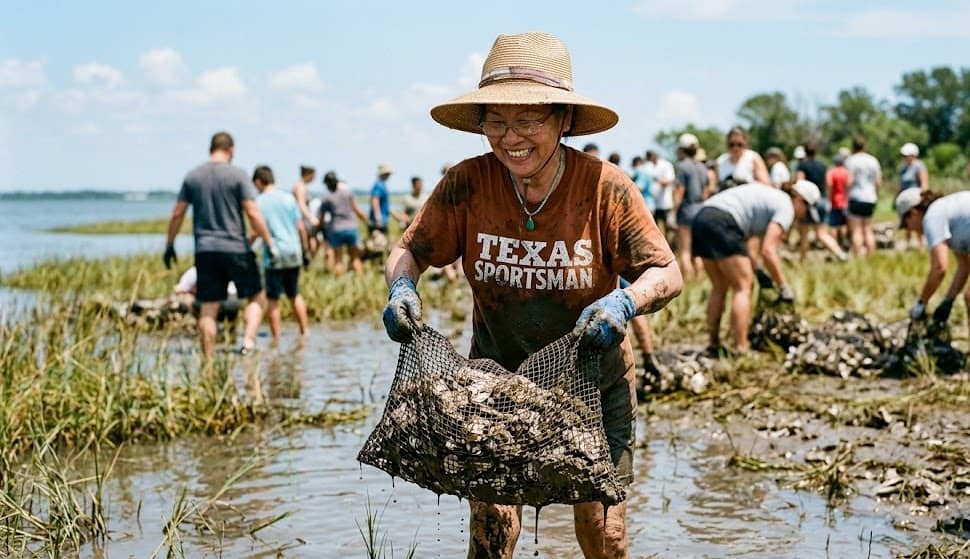
On May 9, 2026, the program hosted its annual community restoration event at Goose Island State Park near Rockport, drawing hundreds of volunteer anglers who manually bagged and placed thousands of pounds of recycled oyster shell into the shallow waters of Aransas Bay. The Sink Your Shucks™ model relies on partnerships with 14 regional restaurants, three major oyster festivals, and six commercial oyster farms to divert millions of pounds of shucked shell from landfills back into the marine ecosystem.
Anglers looking at long-term catch rates understand that these benthic habitats act as biological engines. The latest rounds of CCA Texas conservation funding emphasize that direct habitat creation yields immediate dividends for inshore gamefish. When larval oysters attach to these recycled shells, they rapidly build out interlocking networks that solidify the shoreline, stop marsh erosion, and create the complex, multi-layered environments where redfish thrive.
What Shifting Capital Means for the Future of Texas Redfish Tactics
As private money permanently alters the physical geography of the Texas coast, anglers must adapt their on-the-water strategies to match these emerging structural patterns. The reduction of commercial dredging pressure, combined with targeted reef construction in areas like Carlos Bay and the Matagorda complex, means that redfish are beginning to re-establish historical feeding patterns that had been disrupted by habitat fragmentation.
Instead of continuously searching for scattered fish on barren, mud-bottom flats, savvy anglers are increasingly focusing their efforts on the perimeters of these newly restored, high-relief sanctuaries. The vertical structure provides exceptional depth variance, allowing redfish to transition seamlessly from shallow feeding shelves during early morning periods into deeper, temperature-stable ambush zones as the afternoon sun heats the flats. Furthermore, the localized improvements in water clarity generated by active oyster filtration are altering presentation requirements; clearer water demands longer casts, lighter fluorocarbon leaders, and highly realistic artificial presentations to trick pressured slot fish.
Ultimately, the surge of private funding into oyster reef restoration represents a profound shift in the preservation of the Texas coast. By taking direct ownership of habitat health, the Texas angling community is ensuring that the redfish fishery remains incredibly resilient, highly productive, and completely sustainable for generations to come.