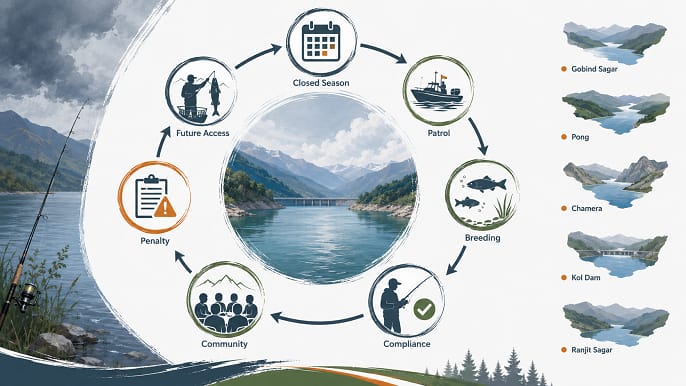
Himachal Pradesh’s closed-season fishing crackdown should matter to Texas anglers because it shows the same rule that applies everywhere fish populations are under pressure: a regulation only works when anglers buy into the reason behind it. Between June 16 and July 9, 2026, Himachal Pradesh’s fisheries department registered 220 illegal fishing cases and recovered more than ₹2.28 lakh in fines during the state’s annual fishing ban. The numbers came from reservoirs, rivers, streams, and local water bodies, but the lesson travels well beyond India. Closed seasons are not paperwork. They are a test of whether fishing communities understand breeding windows, conservation, enforcement, and the long-term access they want to protect.
Why Himachal Pradesh’s Closed Season Became A Test Of Compliance
Himachal Pradesh imposed a two-month fishing ban from June 16 to August 15, 2026, across general reservoirs, rivers, streams, and tributaries to protect fish during the breeding season. The state’s director of fisheries, Vivek Chandel, said the measure was aimed at conserving aquatic resources, supporting natural fish regeneration, and protecting the livelihoods of thousands of fishermen. That is the key point for anglers anywhere: the ban is not just about stopping fishing. It is about giving fish populations time to reproduce before harvest resumes.
The Times of India reported that Himachal Pradesh’s two-month fishing ban applies across major reservoirs and general water bodies, with penalties that can include up to three years of imprisonment, a ₹5,000 fine, or both. Fishing with nets during the ban period was described as a non-bailable offense.
That level of enforcement tells anglers the state is treating the closed season as a serious fisheries-management tool, not a polite request. It also shows why education has to come before punishment. If fishermen only see the ban as lost income or lost recreation, violations become more likely. If they understand the breeding-season logic, compliance has a better chance.
For texassportsmen.com readers, the comparison is clear. Texas anglers already deal with seasons, bag limits, slot limits, ramp rules, invasive-species rules, and public-water requirements. The details change by place, but the principle does not: rule buy-in protects future access.
How 220 Cases Turned Conservation Into A Public Accountability Story
The headline number is sharp: 220 illegal fishing cases between June 16 and July 9. During that stretch, authorities collected more than ₹2.28 lakh in fines from violators. That is not a small misunderstanding scattered across one waterbody. It is a statewide enforcement picture.
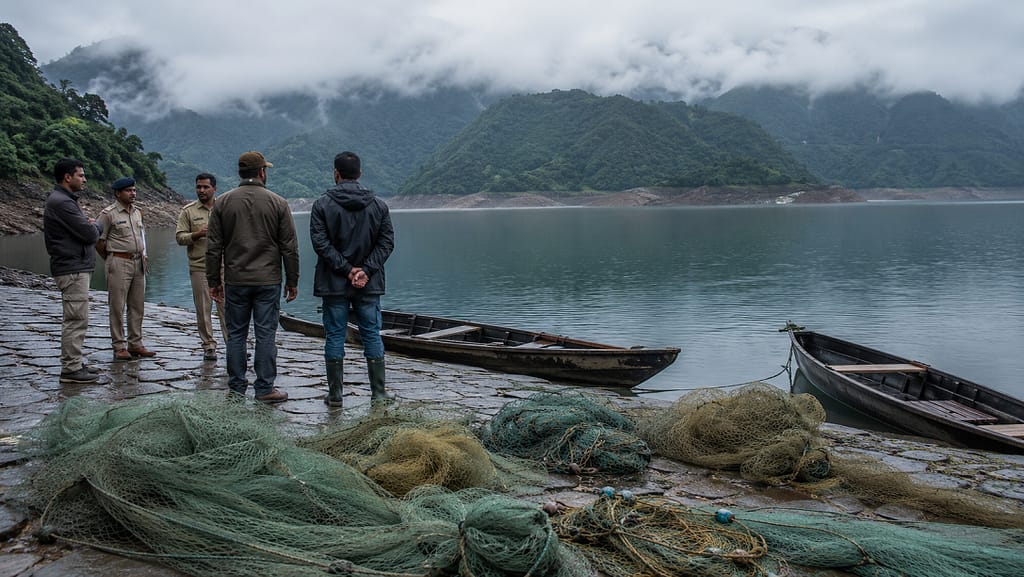
The Times of India’s report on the illegal fishing crackdown said surveillance teams were deployed across major reservoirs, including Gobind Sagar, Pong, Chamera, Kol Dam, and Ranjit Sagar, as well as rivers and streams. The department used special camps, flying squads, regular patrols, boats, vehicles, and foot patrols to monitor water bodies.
That matters because enforcement has to be visible to work. A closed season that exists only in a notice is easier to ignore. A closed season backed by patrols, camps, and local reporting becomes part of the angling culture.
The public accountability piece is also useful. When anglers see case totals, fine totals, and named water bodies, the ban becomes measurable. The public can understand where pressure is happening. Legal fishermen can see that violations are being addressed. Communities can discuss the issue with real numbers instead of vague claims.
Texas fishing debates often work the same way. Whether the subject is red snapper reporting, redfish slot rules, public fishing access, or zebra mussel prevention, data makes the rule easier to explain.
Why Reservoirs Like Gobind Sagar And Pong Matter In The Story
Himachal Pradesh’s major reservoirs are not minor background details. They support fishermen, local economies, food systems, and recreational fishing culture. Gobind Sagar, Pong, Chamera, Kol Dam, and Ranjit Sagar were all named in enforcement coverage, which shows that the closed-season issue is tied to important inland fisheries.
Divya Himachal reported that more than 12,000 fishermen in the state depend on fisheries for their livelihood, with roughly 5,900 working in major reservoirs such as Gobind Sagar, Pong, Chamera, Kol Dam, and Ranjit Sagar. The same report said those five reservoirs cover about 43,785 hectares, while more than 6,000 fishermen use traditional nets across roughly 2,400 kilometers of rivers and tributaries.
Those numbers explain why the issue is bigger than citations. A closed season has to protect fish stocks while also recognizing that thousands of people depend on those waters. That is a difficult balance. Enforcement alone can stop some violations, but it cannot build trust by itself.
The district and reservoir breakdown reported by Divya Himachal makes the pressure more visible. Pong reservoir accounted for 55 cases and ₹52,300 in fines. Gobind Sagar recorded 26 cases and ₹36,000 in fines. Chamera, Kol Dam, and Ranjit Sagar also had cases, while district-level enforcement extended into Bilaspur, Kangra, Chamba, Hamirpur, Kullu, Mandi, Sirmaur, Una, and Solan.
| Area Mentioned In Enforcement Coverage | Why It Matters | What It Shows |
|---|---|---|
| Gobind Sagar | Major reservoir fishery | Enforcement pressure reaches high-value inland waters |
| Pong Reservoir | Large fishing and livelihood base | Highest reservoir case total in the local breakdown |
| Chamera | Mountain reservoir system | Closed-season monitoring extends beyond lower reservoirs |
| Kol Dam | Important reservoir on the Sutlej system | Even smaller case totals remain part of statewide tracking |
| Rivers And Streams | Traditional fishing areas | Closed seasons are not limited to big reservoirs |
That table matters because it shows how closed-season enforcement must cover different types of water, not only one lake or one fishing style.
How This Connects With Texas Fishing Rule Awareness
A story from Himachal Pradesh may seem distant from Texas, but the angler behavior question is familiar. Texas Sportsmen has already covered public fishing rules, invasive-species prevention, red snapper season planning, catch-and-release data, and tournament responsibility. Himachal Pradesh’s closed-season crackdown belongs in the same conversation because it focuses on what happens when rules meet real fishing behavior.
Recent Texas Sportsmen coverage of San Antonio public fishing rules made the same point from a city-access angle. Anglers need to know whether they need a license, where fishing is allowed, what rules apply, and how to share public water responsibly. Himachal’s issue is different in scale and geography, but the habit is the same: check the rule before the first cast.
Texas anglers see this with seasonal openings, bag limits, slot limits, public-water restrictions, and tournament rules. A red snapper season date is not optional. A redfish slot is not a suggestion. A zebra mussel clean-drain-dry rule is not a poster for someone else. A closed season is the same kind of commitment.
That comparison helps make the India story useful for a Texas outdoor audience. It is not about pretending Himachal reservoirs are the same as Texas bays or reservoirs. It is about showing that fishing cultures everywhere face the same pressure point: short-term catches versus long-term access.
Why Closed Seasons Depend On Trust, Not Only Fines
Fines can change behavior, but they do not automatically create support. A closed season works best when anglers believe the rule protects something they care about. In Himachal Pradesh, that means breeding fish, reservoir livelihoods, river fisheries, and future harvest. In Texas, it may mean red snapper access, trout recovery, bass tournament health, public-water opportunity, or coastal resource protection.
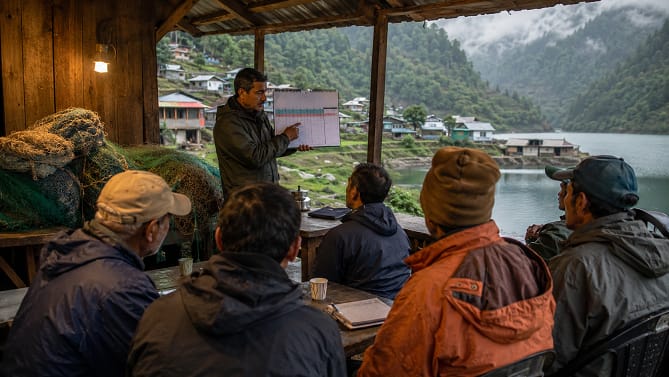
The difficult part is that closed seasons often land hardest on the people most connected to the water. A fisherman who depends on daily catch may feel the ban immediately. A recreational angler may see a closed period as lost opportunity. A market seller may feel pressure from reduced supply. That is why communication matters.
Authorities have to explain what species are being protected, why the dates matter, how breeding cycles work, what the penalties are, and how compliance benefits legal fishermen after the season reopens. Without that, a ban can feel detached from the community it is supposed to help.
The Himachal case shows both sides. The state had a clear closed season and enforcement network. Yet 220 cases still appeared in less than a month. That does not mean the rule failed. It means buy-in has to be strengthened alongside patrols.
Anglers are more likely to respect a closed season when they see it as their own conservation tool, not just a government restriction.
How Enforcement Camps And Flying Squads Change The Risk Calculation
Himachal Pradesh’s enforcement model used camps, flying squads, patrols, boats, vehicles, and foot monitoring. That mix matters because illegal fishing does not happen in one predictable way. Some violations may happen on reservoirs. Others may happen along rivers, small streams, or local markets. Enforcement has to match that spread.
The state’s 2026 ban coverage said surveillance teams, monitoring camps, and flying squads were deployed across major reservoirs. Later enforcement reporting said action would continue through the restricted period. That continuity matters because a closed season runs for two months, not two days.
For anglers, enforcement changes the risk calculation. A person who thinks nobody is watching may decide to fish anyway. A person who sees patrols, case totals, and fines may pause. That pause can protect fish during a sensitive window.
For communities, visible enforcement can also protect legal fishermen from being undercut by violators. If some people ignore a ban while others comply, resentment grows. A rule is easier to support when responsible anglers believe everyone is being held to the same standard.
Tournament organizers and fishing clubs can learn from this. Enforcement does not always have to come from government alone. Clear rules, visible reminders, peer accountability, and community leadership can reduce violations before official action is needed.
Why Closed Seasons Should Be Part Of Angler Education
Closed seasons are often explained in legal language, but they should also be taught as part of angler education. A young angler should learn not only how to cast, measure fish, and read water, but also why certain weeks or months may be off-limits.
This is where Texas programs and India’s closed-season example connect. Youth fishing, public park programs, urban angling, and local tournaments all teach habits. If those habits include regulation literacy early, enforcement problems can shrink later.
A beginner who understands breeding-season protection is less likely to see a closure as random. A tournament angler who understands fisheries management is less likely to treat rule compliance as a burden. A family that learns why closed seasons exist can pass that ethic to the next generation.
In Himachal Pradesh, the ban protects breeding and natural regeneration. In Texas, different rules protect different species and habitats, but the education goal is the same. Anglers should learn that restraint is part of the sport.
The best anglers do not only know how to catch fish. They know when not to fish.
What Texas Anglers Can Learn From Himachal Pradesh
Texas anglers do not need to copy Himachal Pradesh’s rulebook to learn from the case. The useful lesson is cultural. Fishing access survives when anglers accept that some limits are there to protect the next season, not punish the current one.
A Texas angler planning a trip can take three lessons from this story.
First, rule awareness should come before gear preparation. A person should check seasons, licenses, limits, waterbody-specific rules, and conservation requirements before the trip begins.
Second, compliance is a community issue. If responsible anglers stay silent while others violate closed seasons, illegal pressure becomes normalized.
Third, enforcement data matters. Case counts, fine totals, patrol coverage, and named water bodies help make resource protection visible. Anglers may not agree on every rule, but they need real information to debate them honestly.
That is why the Himachal Pradesh crackdown belongs on a Texas outdoor site. It gives anglers a clear international example of what happens when a closed season meets real-world pressure.
Why Angler Buy-In Decides The Value Of Any Closed Season
Himachal Pradesh’s 220 illegal fishing cases show that a closed season cannot rely on a government notice alone. It needs patrols, fines, public reporting, and legal consequences. More than that, it needs anglers to understand why the pause exists.
The June 16 to August 15 ban is designed to protect fish during breeding season. The 220 cases and ₹2.28 lakh in fines show that enforcement is active. The named reservoirs and districts show that the issue reaches across major fishing waters. The livelihood numbers show why the stakes are real.
For Texas Sportsmen readers, the lesson is direct. Whether the rule is in India, Texas, a mountain reservoir, a city river, or a coastal bay, fishing communities have to decide whether they want short-term exceptions or long-term access. A closed season works only when enough anglers choose the second option.
That is why Himachal Pradesh’s crackdown is more than an India fisheries story. It is a reminder that conservation is not only written by agencies. It is decided every time an angler chooses whether to follow the rule when nobody is standing beside them.