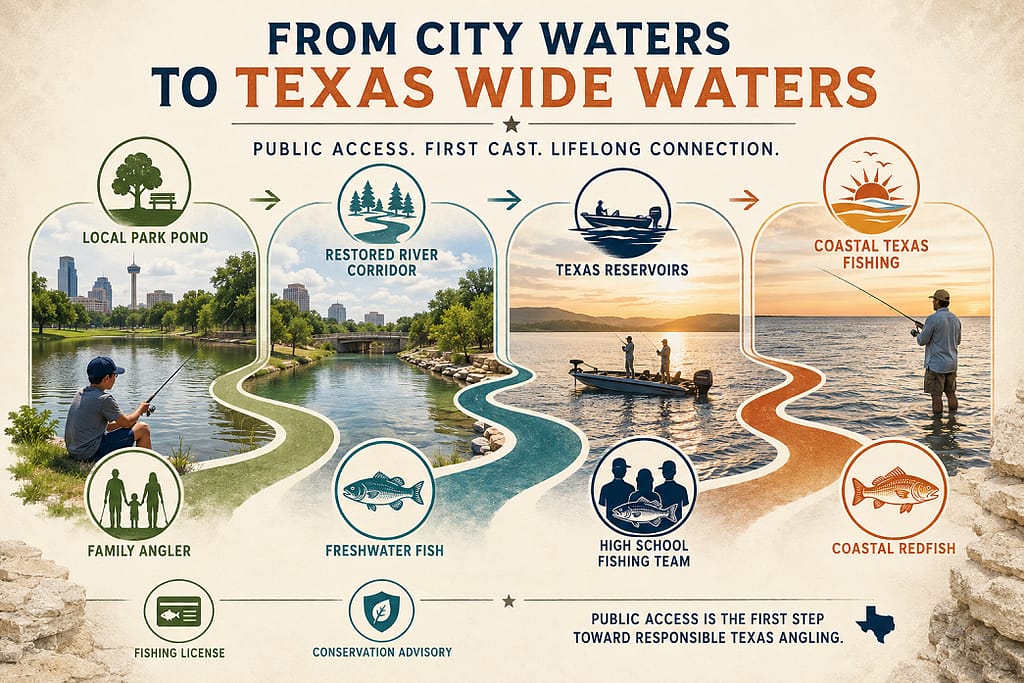
San Antonio fishing is usually discussed differently than coastal redfish tournaments, offshore snapper runs, or high school bass events. Yet the city’s public-water rules show why urban angling belongs inside the same Texas sportsmen conversation. MySA reported on July 5, 2026, that fishing is legal along the San Antonio River Walk and other public waters when anglers have the proper Texas fishing license and freshwater endorsement. That matters because urban fishing is not a side hobby outside the outdoor sports world. It is often the first place families, young anglers, casual fishermen, and city residents learn how rules, access, species, conservation, and public behavior all fit together.
Why San Antonio Turns Fishing Access Into A City Sports Story
San Antonio gives Texas fishing a different kind of stage. Instead of a bay boat idling at first light or a bass team launching at Sam Rayburn, the city’s angling scene can happen near downtown walkways, public parks, restored river habitat, neighborhood ponds, and family recreation areas. That makes the sport more visible to people who may not own a boat, live near the coast, or belong to a tournament trail.

The City of San Antonio’s public fishing guidance says a valid fishing license with a freshwater stamp endorsement is required to fish in public water. The city also lists public fishing locations such as Brackenridge Park, Elmendorf Lake Park, Wheeler Park, and Woodlawn Lake Park. Those details show that fishing access is built into the city’s park and recreation system, not treated as an odd exception.
That changes the way Texas outdoor sports should be covered. Public fishing rules in San Antonio help explain how new anglers enter the sport before they ever consider tournament fishing, coastal travel, or specialized equipment. A person who learns to cast at Woodlawn Lake or Brackenridge Park may later fish rivers, reservoirs, bays, or youth events. Urban access can be the first step in a longer outdoor pathway.
For texassportsmen.com readers, that pathway matters. Texas fishing culture is strongest when it includes both experienced competitors and people learning the basics in public spaces.
How The River Walk Fits Into A Bigger Angling Map
The San Antonio River Walk is better known for restaurants, hotels, festivals, and tourism than for fishing, but the public-water rules make clear that angling can exist inside that urban setting when anglers follow state and local requirements. MySA’s July 5 report highlighted the River Walk question directly, noting that fishing is legal with the proper license and freshwater endorsement.
The best fishing spots are not necessarily the most crowded tourist sections. The report pointed to places such as the Museum Reach near the Pearl, Mission Reach near Espada Park, and Brackenridge Park as better options for anglers looking for room, habitat, and fish variety. That distinction is important because urban fishing requires situational awareness. The question is not only whether fishing is allowed. It is where fishing makes sense.
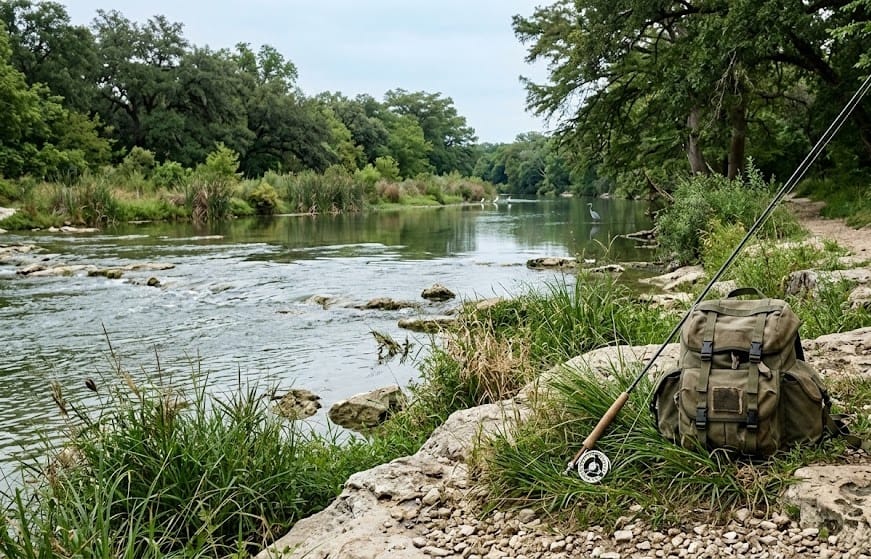
The San Antonio River Authority’s Mission Reach habitat work describes the Mission Reach as a restored 9-mile section of the San Antonio River with natural instream habitat and wide native riparian corridors. That gives the fishing story more depth than a simple rules explainer. Better habitat can make city fishing more practical, more visible, and more connected to conservation.
Urban fishing also forces anglers to share space. Walkers, cyclists, tourists, families, photographers, runners, and park users may all be nearby. That means good fishing behavior includes more than a legal license. It includes casting safely, managing hooks, disposing of line properly, respecting public space, and knowing when a crowded location is not the right place to fish.
Why License Rules Matter Before The First Cast
San Antonio’s public fishing rules are a useful reminder that access does not erase responsibility. A public park or river walkway may feel casual, but Texas fishing laws still apply. Texas Parks and Wildlife says a valid fishing license with a freshwater or saltwater endorsement is required of any resident who fishes or takes fish, mussels, clams, crayfish, or other aquatic life in the public waters of Texas, unless an exemption applies.
That rule matters especially in urban settings because many new anglers may not know where the line sits between casual recreation and regulated fishing. A person who fishes once a year at a park may not think like a tournament angler, but the license requirement still matters. Public access is not the same as rule-free access.
The Texas Parks and Wildlife Department’s fishing license guidance gives anglers the official source for license and endorsement requirements. TPWD also lists a freshwater fishing endorsement as required in addition to a valid fishing license when taking or attempting to take fish in Texas public fresh waters, unless the angler is exempt.
This connects directly with earlier Texas Sportsmen coverage of Texas redfish regulations. Whether the subject is coastal redfish or urban freshwater fishing, the same principle applies: anglers should know the rulebook before they worry about the catch. Much like a dedicated sports fan looking up how to bet on football from Texas to understand the landscape before kickoff, responsible anglers know that proper preparation is the foundation of success.
That is why urban fishing belongs in the sportsmen conversation. It teaches the basic habit that every serious angler eventually needs: check the rules first.
How Urban Fishing Can Build New Anglers Before Competition Starts
Not every angler starts with a tournament boat, a guide trip, or a family cabin near a lake. Some start with a spinning rod, a public pond, and a short trip after school or work. San Antonio’s public fishing access gives that kind of angler a real entry point.
That matters for youth development. A young person who learns to fish in a city park can begin building skills without a major travel budget. They can learn how to cast, identify species, handle fish, release fish, read water, respect limits, and understand why public spaces need care. Those lessons may look small, but they are the foundation of competitive fishing, conservation, and lifelong outdoor participation.
Urban fishing can also widen who gets to participate. A family without a boat can still fish. A parent with only a few hours on a weekend can still take a child to a public park. A beginner can practice without committing to an expensive trip. A student can learn the basics before joining a school fishing program or visiting larger Texas reservoirs.
| San Antonio Fishing Setting | What It Teaches New Anglers | Why It Matters |
|---|---|---|
| River Walk / Museum Reach | Public-space awareness and urban casting discipline | Shows anglers how to share crowded water responsibly |
| Mission Reach | Habitat, restored river function, and species variety | Connects fishing with conservation and river health |
| Brackenridge Park | Family-friendly access and year-round recreation | Gives beginners a practical place to learn |
| Woodlawn Lake Park | Neighborhood fishing opportunity | Keeps fishing accessible without long travel |
| Elmendorf Lake Park | Public-water rules and park-based angling | Builds local participation in outdoor sports |
This is the same development logic that appears in high school fishing, only earlier in the pathway. Before young anglers compete for school points or scholarships, many need a first place to fish.
Why Consumption Guidance Adds Another Layer Of Responsibility
Urban fishing also raises a question that coastal and reservoir anglers know well: can you eat what you catch? MySA reported that fish caught in the San Antonio River are generally considered safe to eat, citing the San Antonio River Authority. That point is useful, but responsible anglers should still know how to verify advisories and make location-specific decisions.
The Texas Department of State Health Services maintains a fish consumption advisory viewer that helps Texans check health advisory information for fish in Texas bodies of water. That tool matters because consumption advice can vary by location, species, and advisory status.
For San Antonio anglers, this adds another layer to public fishing literacy. A legal catch is not the only question. Anglers also need to understand whether they intend to keep fish, whether the species and size are legal, whether an advisory applies, and whether catch-and-release makes more sense for a given trip.
This is where urban angling can become a strong teaching environment. Beginners can learn that responsible fishing does not end at “can I fish here?” It includes “should I keep this fish?”, “how should I handle it?”, “what does the advisory say?”, and “what happens if I do not plan to eat it?”
Those questions make urban fishing more serious than it may look from a sidewalk.
How Public Rules Protect Fish, Parks, And Other Users
Public-water fishing depends on shared trust. If anglers leave line behind, crowd walkways, mishandle fish, ignore license requirements, or treat public parks like private launch ramps, access becomes harder to defend. San Antonio’s rules matter because they protect both the fishery and the people around it.
TPWD’s license and endorsement framework is one part of that system, but public-space behavior matters just as much. Anglers should avoid casting across trails, leaving hooks near walkways, discarding soft plastics or bait containers, or blocking public spaces. In a city park, fishing is one activity among many. The strongest anglers understand that access survives when they behave like responsible users, not entitled ones.
That is a sportsmanship issue as much as a legal one. Texas fishing culture often talks about conservation on lakes and coasts, but the same ethic belongs in urban parks. A clean, careful, respectful angler helps preserve public fishing access for the next person.
San Antonio’s public-water rules also give city residents a clearer path into the state’s outdoor identity. A person does not need to start with a boat, a tournament jersey, or a long drive to the coast. They can start with the nearest public water, the right license, and enough respect for the rules to fish responsibly.
Why Urban Angling Belongs Beside Tournament And Coastal Coverage
Texas Sportsmen has covered large fishing tournaments, coastal redfish rules, red snapper planning, youth fishing, and local tournament momentum. San Antonio’s public fishing rules may seem smaller than those stories, but they belong in the same sequence because they answer a different part of the participation question.
Tournaments show where fishing can go. Urban access shows where fishing can begin.
That connection matters because Texas fishing needs more than elite competitors. It needs beginners, families, youth anglers, urban residents, conservation-minded park users, and casual fishermen who understand basic rules. Without that broad base, tournament growth becomes disconnected from everyday public access.
San Antonio also reminds anglers that Texas fishing is not only coastal or rural. Major cities are part of the outdoor sports map. Restored river corridors, public lakes, neighborhood parks, and accessible fishing locations can bring the sport into daily life for people who might never plan a weekend at the coast.
That is why urban angling deserves a place in Texas outdoor coverage. It helps explain how the sport stays visible, local, and teachable.
What San Antonio Anglers Should Check Before Heading Out
The practical checklist is simple but important. San Antonio anglers should confirm whether they need a Texas fishing license and freshwater endorsement, check the specific public location they plan to fish, review TPWD rules, look for consumption advisories when keeping fish, and respect park users around them.
They should also choose locations that fit the trip. A beginner with kids may prefer a public park with space and easier access. A more experienced angler may look for less crowded sections along the Mission Reach or Museum Reach. Someone fishing near downtown should think carefully about crowds, casting angles, and whether a better river section would be safer and more respectful.
Urban fishing works best when anglers treat the city as part of the fishery, not an obstacle around it. Sidewalks, bridges, habitat restoration, park rules, and other users all shape the experience.
Why San Antonio’s Rules Matter Beyond The River Walk
San Antonio’s public fishing rules matter because they show how outdoor sports can live inside a major Texas city. The River Walk question may get attention because it surprises people, but the deeper story is broader: public fishing gives beginners a way in, teaches regulation awareness, connects residents with restored water, and makes angling visible in everyday urban life.
That belongs in the Texas sportsmen conversation. A person who learns to fish responsibly in San Antonio may become a better lake angler, a better coastal visitor, a better tournament participant, or a parent who introduces the next generation to the sport.
Texas fishing does not only happen at dawn on a boat ramp. It also happens after work, near a trail, in a public park, beside a restored river, and in the hands of someone learning the rules for the first time.
San Antonio proves that urban angling is not separate from Texas fishing culture. It is one of the places where that culture can grow.