
For competitive anglers, success is measured in pounds and ounces. But the true mark of a champion extends beyond the scale.
Responsible handling of every bass is a fundamental duty. It ensures the sport’s future and protects the resource we all love.
Recent scientific reviews reveal a compelling story. In well-managed events, post-release mortality rates can be remarkably low, often below 5%.
This statistic isn’t guaranteed. It hinges on critical factors like water temperature, tournament duration, and, most importantly, angler knowledge and diligence.
The public’s view of bass fishing is shaped by what they see. Demonstrating a commitment to stewardship is essential for maintaining the sport’s social license.
Ethical practices are not optional extras. They are the core of modern tournament angling’s sustainability and public image.
Mastering livewell management and proper fizzing techniques is where theory meets practice. For a detailed look at rules and best practices in action, explore our guide to fishing competitions in Texas.
Livewell setup: fill, recirc, ice, oxygen additives; temp management by season
Setting up your boat’s livewell right is key. It should be a recovery area, not a stressful place. The setup changes with the seasons. What’s good in spring might harm fish in summer.
Experts say water temperature controls everything in livewell settings. Following temperature-based rules, like those from B.A.S.S. livewell management, boosts survival rates. Here’s how to adjust with the seasons.
https://www.youtube.com/watch?v=Wl7PvOPVMj0
Your livewell does two main things: exchanges water and controls temperature. How you balance these changes with the lake’s temperature.
Below 75°F: The Fresh Water Cycle
In cooler water, fish are less stressed by warmth. Focus on keeping water quality high. Use the “fill” or “fresh water” mode for 5-10 minutes every half hour. This brings in fresh, oxygen-rich water and removes waste. Only use recirculation briefly between fill cycles.
Between 75°F and 80°F: The Continuous Recirculation Shift
As temperatures rise, the risk of thermal shock grows. Avoid pumping in hot surface water. Switch to continuous recirculation mode. This keeps the water stable, a bit cooler than the lake. Run the aerator or oxygenator constantly to keep oxygen levels up.
Above 80°F: The Ice & Extreme Caution Zone
Summer heat requires careful livewell management. Keep using continuous recirculation. Ice can help, but use it carefully. Aim to cool the water slowly—no more than 8 to 10 degrees Fahrenheit below the lake. Avoid sudden changes in temperature.
| Seasonal Condition | Water Temp Range | Primary Fill Mode | Recirculation Use | Ice & Additives Guidance |
|---|---|---|---|---|
| Cool Conditions | Below 75°F | Intermittent Fresh Water | Minimal; between fill cycles | Rarely needed. Focus on fresh water exchange. |
| Warm Transition | 75°F – 80°F | Minimal Fresh Water | Continuous | Use oxygen additives. Ice only if temp steadily climbs. |
| Hot Summer | Above 80°F | Avoid Fresh Water Intake | Continuous, with aeration | Ice is recommended, but cool slowly (max 8-10°F drop). Use oxygen supplements. |
Essential Setup Details
There are key livewell best practices for every tournament day.
Keep It Full: A full livewell reduces sloshing, which harms fish. It also keeps temperature and water chemistry stable.
Divide Your Catch: If you have a five-fish limit, don’t put them all in one spot. Use multiple livewells or dividers. This reduces stress from overcrowding.
Use Lid Ventilation: Many livewells have vents or aftermarket devices. These let out harmful gases while bringing in fresh air. Always make sure vents are open.
Oxygen Additives: In warm water, oxygen levels drop. Using oxygen supplements or a pure oxygen system can save fish. Follow the product’s instructions carefully.
Mastering these livewell best practices turns your boat into a recovery center. It’s not just about storing fish; it’s about supporting their health during stress. This care is essential for successful handling and release later.
Handling: wet hands, vertical hold cautions, hook removal, barbless options for practice
Weigh‑in etiquette starts at the boat, not the stage. It’s about protecting the fish’s slime coat and organs. This is where your technique meets fish welfare.
Your first touch is key. Always wet your hands or wear wet gloves before touching a bass. This keeps the slime coat safe. Never put a fish on a dry boat carpet or hot surface. Hold the fish by the lower jaw at the boat side for control.
How you hold the fish matters a lot. For small bass, a brief vertical hold is okay. But for bigger fish or photos, use a two-handed horizontal support. This keeps the body supported evenly.
Avoid swinging or shaking the fish at all costs. This can hurt the fish’s jaw and tissues badly. Move the fish smoothly and carefully.
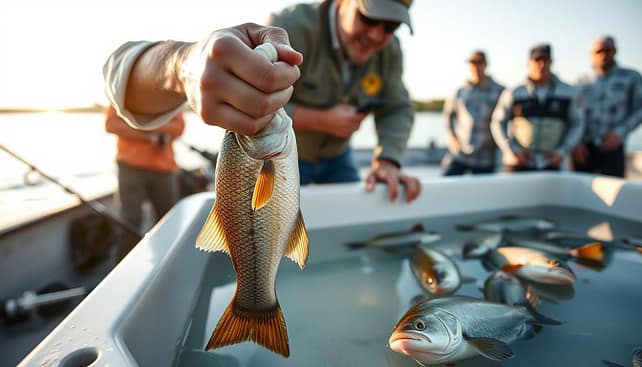
Quickly removing the hook is important. The less time the fish is out of water, the better. Use long-nose pliers for a good grip. For tricky treble hooks, follow a guide like this one on safe treble hook removal to avoid damage.
Practicing with barbless hooks helps improve your speed and technique. Crimp your barbs down during practice. This makes removing hooks faster and easier, preparing you for tournaments.
| Scenario | Proper Technique (Do) | Common Mistake (Don’t) |
|---|---|---|
| Boat-Side Landing | Wet hands first, grasp lower jaw firmly over the water. | Use a dry towel or place fish on dry carpet. |
| Gripping the Fish | Support the body with your other hand for larger bass. | Hold large fish vertically by the jaw alone. |
| Holding Position | Use horizontal, two-handed cradle for fish over 7 lbs. | Swing, shake, or “pose” a heavy fish vertically. |
| Hook Removal | Use pliers, push hook out along the curve swiftly. | Yank or pull blindly, tearing the fish’s mouth. |
| Practice & Preparation | Use barbless hooks in practice to build skill. | Only practice hook removal during the tournament. |
These handling skills keep the fish in top shape. It’s ready for the livewell or the scale. Good weigh‑in etiquette, starting at the boat, shows you care about the fish.
Fizzing Deep Fish: A Lifesaving Skill for Barotrauma
Expert angler Joe Balog says learning to fizz a fish is essential for deep-water fishing. Bass with barotrauma, or “the bends,” have almost no chance of survival if released without help. So, fizzing deep fish is a must for any serious angler fishing over 25 feet deep.
Barotrauma happens when a fish’s swim bladder expands too fast when brought up. This can push organs out of place, causing the stomach to bulge and eyes to bulge. Without help, the fish can’t swim down and will die.
When Does a Fish Need Fizzing? Here’s a quick guide. Fizz a fish if it shows any of these signs:
- Cannot swim down or maintain balance.
- Has a distended, protruding stomach.
- Floats listlessly on its side at the surface.
- Was caught from water deeper than 25-30 feet.
If the fish swims away strongly, fizzing is not needed.
Gather the Right Tools:
- A specialized fizzing needle (hypodermic) or a 16-18 gauge medical needle.
- Rubbing alcohol or antiseptic to disinfect the needle.
- A measuring tool (like a ruler) to gauge insertion depth.
The Step-by-Step Fizzing Technique: Follow this ordered process carefully.
- Wet your hands and the fish’s side thoroughly. Lay the fish on a wet, soft surface, preferably on its side.
- Locate the insertion point. The recommended method is side insertion, not through the mouth. Find the point where the hard edge of the pectoral fin meets the body.
- Measure the needle. For most bass, insert no more than 1 to 1.5 inches deep, angled slightly toward the head.
- Insert the disinfected needle smoothly at the measured spot. You should hear a faint hiss of escaping gas.
- Hold the needle in place for 2-3 seconds, then withdraw it gently.
- Immediately place the fish back in the water, supporting it upright. It should regain equilibrium and swim down.
The most critical rule: practice on dead fish first. Get your aim, depth, and feel right before trying it on a live fish. Quick and confident handling is key.
For those who learn better by watching, certified training videos are a must. They show the side-insertion technique that pros like Joe Balog recommend.
The Alternative: Slow Ascent Recompression. Sometimes, you can avoid fizzing. The “slow ascent” method uses a weighted release device to lower the fish back to its capture depth. This method is good for fish with mild symptoms or if you’re not sure about fizzing.
| Method | Best For | Key Advantage | Key Consideration |
|---|---|---|---|
| Fizzing (Venting) | Fish with severe barotrauma (protruding stomach, cannot right itself). | Immediate relief; allows for quick weigh-in and release. | Requires training, tools, and practice to perform safely. |
| Slow Ascent Recompression | Fish with mild symptoms or caught from moderate depths. | Non-invasive; allows natural healing of the swim bladder. | Requires special descending gear; takes more time per fish. |
| No Intervention | Fish that swim down strongly upon surface release. | Simplest and fastest. | Never an option for a fish displaying clear barotrauma signs. |
Learning to fizz deep fish makes you more than just a fisherman. It shows you care about the fish and the sport. By mastering this skill, you give your catch a chance to live another day.
Weigh‑in flow: bags, shortest air‑time, release boat use
From the moment you pull your fish from the livewell to its return to the water, the weigh-in sequence demands careful execution. This stage is a major stress bottleneck. A smooth flow protects fish health and supports conservation. It hinges on three pillars: proper bag use, minimal air exposure, and effective release boat logistics.
Using the Right Bag is the First Step. Always use a high-quality, fish-friendly weigh-in bag. Fill it with water from your livewell, not the lake. This maintains stable temperature and chemistry. Keep your fish submerged in this bag while waiting in line. Handling them repeatedly adds stress. Data from B.A.S.S. confirms this simple act is a core part of proper weigh-in etiquette.
The Clock is Ticking on Air Exposure. The goal is the “shortest air-time” possible. Once your bag is on the scale, have the official weigh your fish quickly. Lift them only for the brief moment needed for the scale and photo. Every second out of water impacts their gills and stress levels. Fisheries science shows minimizing air exposure is a top factor in post-release survival.
Be ready. Know your bag’s weight. Have your hook remover handy if needed. This preparedness speeds up your stage time. It shows respect for the fish and the anglers behind you. It turns good weigh-in etiquette into a standard practice.
Release Boats Are Conservation Heroes. After weigh-in, release boats take over. They are not just transportation. Their role is ecological. Instead of dumping all fish at the dock, these boats distribute them across the waterbody. This prevents stockpiling. It also reduces displacement stress, a serious concern noted in fisheries journals.
When fish are released in one spot, they are vulnerable. They can be disoriented and easily picked off by predators. Release boats mitigate this by spreading the fish out. This practice helps maintain the fishery’s balance. It is a key improvement over traditional mass release.
| Practice Area | Traditional Method | Best Practice & Benefit |
|---|---|---|
| Bag Use | Dry bag or minimal water; fish handled out of bag in line. | Bag filled with livewell water; fish remain submerged until weigh-in. Reduces physical handling stress. |
| Air-Time Management | Fish held out of water for extended periods during photos and weighing. | Weigh and photo coordinated for speed; fish out of water for less than 10 seconds. Preserves gill function and reduces shock. |
| Release Strategy | All fish released at the dock or a single shoreline point. | Use of release boats to distribute fish across multiple locations. Minimizes displacement stress and predator concentration. |
| Angler Role | Focus solely on weight; process is the tournament’s responsibility. | Angler is proactive: pre-filled bag, ready for scale, supports release boat system. Directly contributes to higher survival rates. |
Mastering this flow creates a win-win. You follow the rules and help ensure the fish you release swim away strong. It’s a commitment to the future of the sport. By understanding the science behind bags, air-time, and release boats, you become a steward of the water.
Post‑event reporting: mortalities and improvements
Post-event reporting turns a single tournament into a treasure trove of ecological data. It shows a deep commitment to conservation that goes beyond the tournament day. It involves a careful review of what happened to the fish.
Why is tracking mortality numbers so important, even if they’re low? It creates a powerful cycle of feedback. It helps spot trends over time. Was there a rise in deaths on very hot days? Did a new way of handling fish make a difference?
This info is priceless for continuous improvement. Clubs can tweak their rules and teach anglers better. More importantly, they offer solid proof to fisheries managers. This data shows how tournaments affect the fish population.

What data should your club gather? Stick to clear, measurable metrics. A simple form after the tournament can get the basics.
- Total number of fish weighed in.
- Number of observed mortalities at the weigh-in.
- Water temperature and weather conditions.
- Tournament format (e.g., five-fish limit, catch-weigh-release).
- Any notable handling challenges observed.
This isn’t about pointing fingers. It’s about building a knowledge base. With this data, a club can move from making guesses to making informed decisions.
How do you use this data wisely? First, review it after each event. Talk about what might have caused any problems. Second, share anonymized summaries with your state’s fisheries agency. This builds transparency and trust.
This reporting empowers advocacy. Solid data supports new tournament formats like release-at-capture. It also helps clubs adjust to warmer waters by proving the need for seasonal rule changes.
Thorough post-event reporting makes your club a key player in long-term solutions. It turns every tournament into a lesson that helps future conservation efforts.
Club policy templates
Being skilled is important. But, having a standard for fish care in tournaments is key. The last step is to write down the best practices in a club policy.
Guidelines from B.A.S.S. are a great start. Studies in fisheries journals back up the need for clear, adopted standards. A good policy template turns expert advice into rules for your club.
Your club’s fish care policy should cover important areas. It should set livewell standards for fill rates, aeration, and temperature. It should also have rules for handling fish, like using wet hands and proper holds.
The template should also detail weigh-in procedures. This includes how to use bags, minimize air exposure, and use release boats. It should also include a section on reporting any fish that died after the event. This helps improve future events.
Creating official club policy templates raises the bar for everyone. It makes sure all anglers follow the same rules. It educates new members and shows your club’s commitment to ethical fishing.
This public commitment strengthens the sport’s future. A written policy shows your club is serious and responsible, dedicated to the resource.