
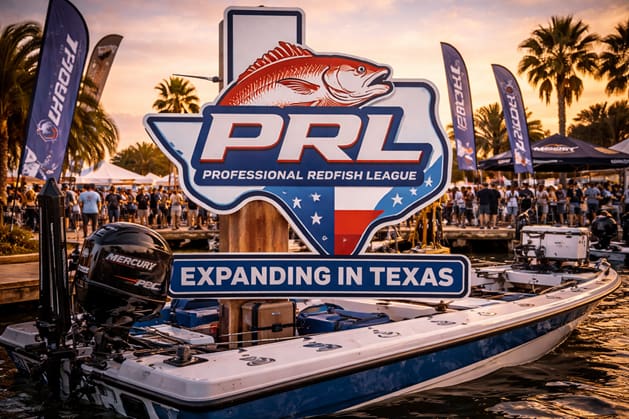
The Texas tournament scene has been growing for years, but 2026 is marking a different kind of evolution—one driven not just by participation, but by structure. The expansion of the Professional Redfish League (PRL) into multiple divisions is reshaping how anglers enter, compete, and progress within the sport.
Instead of a single competitive lane, the PRL is building a layered system. That shift is subtle on the surface, but it carries major implications. It means more anglers can compete, more formats can coexist, and the pathway from weekend competitor to elite-level angler is becoming clearer than ever.
Why More Divisions Are Being Introduced
The expansion isn’t random—it’s a direct response to the rapid growth of tournament fishing across Texas. As participation increases, a single division simply can’t accommodate the range of skill levels, budgets, and goals now present in the field.
By introducing multiple divisions, the PRL is addressing several realities at once. New anglers need accessible entry points. Experienced teams want higher-level competition. Sponsors and organizers need formats that attract both.
This approach allows the league to scale without compromising competitive integrity. Instead of overcrowded tournaments where skill gaps are wide, divisions create more balanced competition within each tier.
How The Division Structure Changes Competition
The introduction of divisions fundamentally changes how anglers approach tournaments. Instead of competing in a single open field, anglers now have options that better match their experience and ambition.
At the top level, elite divisions concentrate the most skilled teams. These events demand precision, consistency, and the ability to perform under pressure across multiple days.
Lower or intermediate divisions, on the other hand, provide a proving ground. Anglers can develop patterns, refine decision-making, and build confidence without being immediately outmatched by seasoned pros.
This layered format is similar in philosophy to what’s already happening across the broader Texas scene, where the tournament participation boom has created demand for more structured pathways into competitive fishing.
The Impact On Strategy And Preparation
With multiple divisions in play, strategy begins long before tournament day. Anglers must now decide not just how to fish, but where they fit within the competitive structure.
Those targeting higher divisions are investing more time in pre-fishing, refining seasonal patterns, and preparing for varying conditions across multiple bays. Consistency becomes the defining factor—finding two quality slot fish isn’t enough if it can’t be repeated event after event.
Meanwhile, anglers in developing divisions are focusing on efficiency and learning curves. They’re building confidence in areas like:
- Pattern recognition across changing tides
- Time management during tournament windows
- Adjusting to pressure from other boats
The presence of divisions allows these skills to develop progressively, rather than all at once under elite-level pressure.
Expanding Opportunities For New Anglers
One of the most important outcomes of this expansion is accessibility. For years, one of the biggest barriers in tournament fishing was the jump from recreational angling to high-level competition.
Divisions help close that gap.
Instead of stepping directly into events dominated by veteran teams, newer anglers can compete within a more appropriate field. That creates a more engaging experience, which in turn helps sustain long-term participation.
It also creates momentum. As anglers improve, they can move up divisions, building both skill and reputation over time.
Increased Pressure On Texas Fisheries
As with any expansion, there’s a tradeoff. More divisions mean more events, more pre-fishing, and more pressure on key Texas bays.
Areas like Port Aransas, the Laguna Madre, and Matagorda Bay are already seeing increased traffic tied to competitive fishing. With additional divisions, that pressure becomes more sustained throughout the season rather than concentrated in a few major events.
Redfish respond to that pressure. They adjust feeding patterns, shift into less obvious zones, and become more selective—especially in heavily fished areas.
According to NOAA red drum fisheries data, maintaining a healthy fishery under increasing angler pressure depends on both strong population management and responsible fishing practices. The growth of structured leagues like the PRL adds another layer to that equation.
Economic Growth And Industry Expansion
The expansion of divisions doesn’t just affect anglers—it ripples through the entire coastal economy.
More divisions mean more participants, and more participants mean:
- Increased travel to coastal towns
- Higher demand for lodging and marina services
- Growth in tackle, gear, and boat-related spending
For local communities, this creates consistent economic activity rather than isolated tournament spikes. For the fishing industry, it expands the market for both entry-level and high-end equipment.
This economic dimension is one of the reasons leagues are investing in expansion—it supports not just the sport, but the entire ecosystem around it.
The Balance Between Growth And Competitive Integrity
As the PRL continues to expand, the challenge will be maintaining balance. More divisions create opportunity, but they also require careful management to ensure that competition remains meaningful at every level.
If divisions become too fragmented, the sense of prestige at the top could weaken. If they’re too limited, accessibility suffers.
Right now, Texas appears to be navigating that balance effectively. The structure allows growth without losing the competitive edge that defines tournament fishing.
What This Means For The Future Of Texas Redfish Competition
The expansion of the Professional Redfish League is more than a format change—it’s a signal of where the sport is heading.
Competitive fishing in Texas is no longer defined by isolated events or informal circuits. It’s becoming a structured, scalable system with clear entry points, progression paths, and elite tiers.
For anglers, that means more opportunity—but also more expectations. Advancement now requires consistency, adaptability, and a deeper understanding of both the fishery and the competitive landscape.
And as these divisions continue to evolve, one thing is becoming clear: Texas isn’t just hosting redfish tournaments anymore—it’s building the future framework of competitive inshore fishing.