
Forget everything you think you know about shooting arrows. What’s happening here is less a hobby and more a full-blown ecosystem.
It’s a choose-your-own-adventure story, written in flight paths and scorecards. On one side, you have the monastic silence of indoor leagues. Think of the TAIL league, a monthly ritual where the only enemy is your own pulse against a static target.
Then, you flip the page. Suddenly, you’re in the mountains with the Total Archery Challenge. Here, wind, distance, and a sheer cliff face are part of the test. It’s gloriously chaotic.
This isn’t just about hitting a hay bale anymore. It’s a Darwinian playground for those who find their calm in the *thwip* of a perfect release. From the rigorously standardized to the wildly unpredictable, the state has become a petri dish for every style of competitive shot.
Let’s dissect this spectrum. We’ll look at the clubs crafting champions in controlled environments and the events that throw you into the literal wild.
Beginner-Friendly Competitions
Before you dream of being a bowhunting champion, start with the basics. Moving from backyard targets to real competitions is a step-by-step journey. Beginner-friendly leagues are like training wheels for archers, with scores to track your progress.
Why is this important? Trying to run a marathon without jogging first is crazy. The same goes for bow hunting tournaments. Novices shouldn’t jump into complex 3D shoots. They need a place where mistakes teach valuable lessons.
The Tournament Archery Indoor League (TAIL) is a great example. It’s not just a casual shoot. TAIL is designed to help archers improve in a controlled setting. It removes distractions like weather and terrain.
TAIL keeps things simple. You shoot 30 arrows, in 10 sets of three, at 18 meters. This makes competition feel like a personal challenge, not a daunting task.
TAIL’s design is smart. It focuses on your skills, not external factors. You don’t have to worry about wind or uneven ground. It’s just you, your bow, and a target.
Now, let’s talk about the rewards: USA Archery Star Pins. TAIL uses these pins to track your progress. Each color represents a different level of skill.
- Green Pin: Your first achievement, showing you can handle the format.
- Purple & Gray Pins: Intermediate goals, showing your skills are growing.
- White Pin: The top level for beginners, proving you’ve mastered this level.
Getting these pins is about getting better, not just showing off. Each pin marks a score range, giving you clear goals. It’s like earning colored belts in martial arts, but for archers.
This system does two things. It builds your ability to handle pressure and gives you a clear path to improve. It’s like a talent pipeline, showing you’re ready for bigger challenges.
The goal isn’t to stay in beginner leagues forever. It’s to build the skills needed for bow hunting tournaments. Think of TAIL as a simulator for more complex challenges.
So, if you dream of 3D courses or trophy bucks, start with beginner-friendly competitions. They’re not less important; they’re the best way to prepare for the future.
Indoor vs Outdoor Events
Think of indoor archery as a chess game on a flat board. Outdoor archery is like playing that game on a windy mountain trail. The difference between these archery events is not just about the weather. It’s about how you see the world.
Indoor competitions, like the Texas Archery Indoor League (TAIL), are like controlled experiments. The range is 18 meters, and the target is a single or three-spot face. The lighting and air are always the same.
Your main challenge indoors is your own mind. This format tests your form and ability to repeat it. It’s all about precision. You either shoot perfectly, or you don’t. There’s no room for excuses.
Now, let’s go outside. Archery events become more complex here. The Total Archery Challenge is a great example. It’s not just shooting at paper. You face a course with over 100 3D targets, making every shot unpredictable.
Here, distance and angle are hard to guess. A branch might knock your arrow off course. This is applied archery. It’s physical and requires quick adjustments.
So, which one is better for you? The answer is both.
The indoor range teaches you the basics. It shows you how to release the arrow correctly. The outdoor course lets you use that skill in real-life situations. It’s about adapting to the environment.
To choose is to know what you’re training for. Do you want to master the technical side? Go indoor. Or do you want to experience the thrill of field craft? Then, go outdoor.
| Aspect | Indoor Events (e.g., TAIL) | Outdoor Events (e.g., Total Archery Challenge) |
|---|---|---|
| Environment | Controlled, climate-regulated | Natural, subject to weather & terrain |
| Primary Challenge | Consistency & mental focus | Distance judging & obstacle navigation |
| Target | Static paper face (18 meters) | 3D animal targets at unknown distances |
| Skill Emphasis | Form repetition & shot execution | Field estimation & adaptive shooting |
| Best For | Technical refinement & competition prep | Hunting simulation & real-world application |
Doing both types of archery events doesn’t make you split. It makes you a complete archer. The indoor range sharpens your skills. The outdoor course teaches you to use them in real-life situations.
3D Archery Course Tournaments
The pop quiz is over. 3D archery is the final exam, and in Texas, they’ve built an entire theme park around it. This isn’t target shooting; it’s environmental negotiation. Your opponent isn’t just a scoring ring. It’s a slope, a bush, a deceptive shadow, and a foam animal with a strangely judgmental stare.
Take the Total Archery Challenge. They don’t host tournaments; they produce blockbuster adventures. Imagine a 5K hike where every hundred yards, a life-size deer, bear, or elk demands your absolute focus. With over 100 targets strategically ambushed in natural terrain, it’s less a competition and more a survival simulation with a truck as the grand prize. This is the epic scale of archery competitions Texas dreams are made of—a physical and mental marathon where your cardio is as important as your sight pin.
But the 3D scene isn’t all spectacle. For the weekly grind, places like On Target Archery offer the consistent reps. From February through August, they host shoots using ASA rules, often with a “California start” (shoot at your own pace). These events are the lab where you dissect the 3D puzzle: judging unmarked distances, navigating awkward shooting stances, and managing your mental game under less fanfare but equal pressure.
So, why choose this particular flavor of chaos? For hunters, it’s the holy grail of stress-testing. That downhill shot at a bedded elk target? It replicates the heart-pounding moment of a real hunt. The psychological battle—fighting the urge to guess the distance—is the same. 3D courses teach you to read the landscape, not just the target.
| Feature | Mega 3D Event (e.g., Total Archery Challenge) | Local 3D Shoot (e.g., On Target Archery) |
|---|---|---|
| Scale & Atmosphere | Immersive, festival-like experience with 100+ targets on natural terrain. | Focused, club-based atmosphere on a dedicated course. |
| Frequency & Commitment | Annual or semi-annual major events; high commitment, often multi-day. | Weekly or monthly shoots; low commitment, perfect for regular practice. |
| Primary Appeal | The ultimate adventure, physical challenge, and large-scale competition. | Skill refinement, rule familiarity (ASA), and community building. |
| Best For | The archer seeking a memorable test and spectacular challenge. | The archer honing hunting skills or enjoying consistent competitive play. |
Whether you’re chasing the grandeur of a TAC or the disciplined rhythm of a weekly shoot, 3D archery offers the most holistic test of your craft. It’s where precision meets problem-solving, proving that the most engaging archery competitions Texas provides aren’t always on a flat line.
Traditional Archery Competitions
If 3D archery is like a wild adventure, traditional target competitions are like a detective story. Each shot is a clue in a mystery of millimeters. Don’t let the word “traditional” fool you—this isn’t your grandfather’s sleepy backyard pastime.
We’re talking about codified, rule-bound sports archery that forms the backbone of Olympic dreams and serious local circuits. These formal contests are bow hunting tournaments of the mind, where the prey is perfection and the terrain is your own concentration.

Imagine a target face with five small dots arranged like the five on a dice. Your job? Hit each one, repeatedly, from varying distances. It sounds simple until you realize it’s a ruthless exercise in precision and consistency. The mental grind is real. There’s no distracting foam deer or changing light—just you, your bow, and those five mocking dots.
This isolation of pure technique is what makes these events so valuable. They measure the fundamentals without environmental excuses. Mastering the 5-spot builds the same disciplined focus required in actual bow hunting tournaments, where one twitch can mean the difference between a clean harvest and a wounded animal.
Then there’s the team dynamic. Venues like On Target Archery host “Team Shoot” tournaments pairing two archers across three disciplines: 5-spot, Techno Hunt, and 3D. Suddenly, it’s not just your score. It’s shared pressure, whispered strategy, and the camaraderie of collective triumph or failure.
Why subject yourself to this? Because constraint breeds creativity. When you master the “boring” discipline of hitting the same spot endlessly, you build muscle memory that translates directly to success in field scenarios and bow hunting tournaments. The silent hall tension—the click of a sight winder, the thud of arrows—prepares you for the quiet moment before release in the woods.
These aren’t casual gatherings. We’re talking state qualifiers with entry fees and prize money on the line. The format may be traditional, but the stakes are thoroughly modern. It’s where technique is isolated, measured, and ultimately perfected.
| Competition Type | Environment | Primary Challenge | Best For Developing |
|---|---|---|---|
| 5-Spot Tournament | Indoor Range | Absolute Precision & Consistency | Fundamental Technique & Mental Focus |
| Team Shoot | Mixed (Indoor/Simulated) | Collaboration Under Pressure | Strategic Thinking & Adaptability |
| 3D Archery | Outdoor Wooded Course | Judging Distance & Angles | Field Readiness & Instinct |
So yes, you’ll trade woodland adventure for fluorescent lighting. But what you gain is measurable progress. Each tournament round becomes a diagnostic tool, highlighting exactly where your form or focus wavers. In the economy of skill-building, these traditional competitions offer the highest return on investment.
They prove a sage principle: sometimes you need to stand perfectly and shoot at a stationary dot to learn how to hit a moving target in the wild. The silence of the range speaks volumes about your readiness for the field.
Youth Division Opportunities
Forget about participation trophies. Texas youth archery events focus on real achievements. It’s not just about showing up. It’s about teaching young minds focus, discipline, and goal-setting.
The Texas Archery Institute League (TAIL) knows how to do it right. Their age divisions are carefully planned. They have a four-tier system that matches each stage of development:
- Yeoman: 9 years and under
- Bowman: 10-12 years
- Cub: 13-14 years
- Cadet: 15-17 years
This system avoids unfair competition. It’s fair and competitive. Most importantly, it’s human.
The star pin system is like video game badges, but with real skills. Kids earn pins for mastering techniques and hitting scores. It’s visual, progressive, and tangible. They can show off their progress.
This creates positive feedback loops. Small wins lead to bigger challenges. The pin shows that the process works.
The Total Archery Challenge has a “Future Champions” course for beginners. It’s not a watered-down version. It’s a gateway to archery excellence.
This course introduces terrain challenges and varying distances. It’s designed to prepare for big tournaments. It shows that you’re training for the big leagues.
These youth divisions are the sport’s best feeder system. They’re not just for future champions. They’re for adults who understand delayed gratification and quiet concentration.
In today’s world, archery teaches a valuable lesson: stilling yields results. The 30 seconds to draw, aim, and release an arrow is like meditation.
Compare this to playing video games. Both offer achievements and require hand-eye coordination. But only archery teaches the importance of focus in a real environment.
The investment in youth divisions is smart. It’s not about creating prodigies. It’s about creating practitioners. It’s about building a pipeline of individuals who understand mastery in small, consistent increments.
Next time you see a youth division at a Texas tournament, look beyond the bows and arrows. You’re witnessing a clinic in developmental psychology disguised as sport. The targets are foam, but the lessons are concrete.
Equipment Categories & Classes
The equipment check at a major archery competitions Texas hub is more than just an inspection. It’s a way to see different archery styles. Just like you wouldn’t compare a chess player to a speedcuber, archery tournaments separate gear into classes. This way, each type of bow can show off its skills without unfair competition.
Why is this important? It’s like comparing a marathon runner to someone on an e-bike. It’s not fair. Archery classes celebrate different skills and styles.
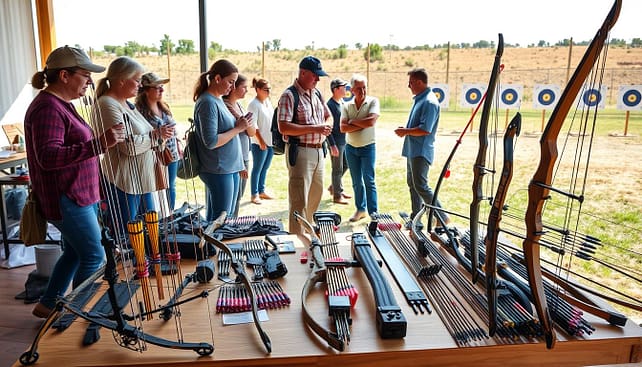
There are three main divisions in archery. They range from the simple, traditional style to the high-tech modern one.
| Equipment Class | The Philosophy | Key Rule & Vibe |
|---|---|---|
| Barebow / Basic Compound | The minimalist. It’s you, the bow, and instinct. No sights, no stabilizers. This is archery reduced to its essence—a test of feel, estimation, and raw form. | No aiming sights permitted. Arrow shaft max diameter: 9.3mm. Think of it as the “unplugged” acoustic session of the tournament. |
| Recurve (with sights) | The classic Olympian. Elegant, demanding, and deeply technical. It uses a sight but lacks the let-off and complex cams of a compound. This is the fencer’s foil—precision through disciplined repetition. | Sights are allowed, but the bow must follow Olympic-style specifications. It’s the balance between tradition and modern aiming aid. |
| Compound (with sights) | The technological orchestra. Cams, stabilizers, magnified sights. This class is about mechanical advantage and eliminating variables. The challenge shifts from fighting the bow to executing a perfect, repeatable shot process. | Full technological suite allowed. Arrow point max diameter: 9.4mm. This rule, like the shaft limit, keeps the “arms race” in check for all Texas tournaments. |
Those arrow diameter limits (9.3mm for shafts, 9.4mm for points) are the great equalizers. They prevent someone from showing up with a ballistically perfect, pencil-thin arrow that laughs at the wind. The rules ensure competition stays focused on the archer, not just the arrow’s engineering.
So, where does your setup fit? Choosing a class is choosing your battlefield. Do you want the bare-knuckle brawl of Barebow? The refined discipline of Recurve? Or the high-precision engineering test of Compound? Your answer defines your entire competitive experience.
For the definitive word on class specifications and rules, always consult the official tournament rules. Knowing your category inside and out is the first strategic win in any Texas archery event.
Registration & Entry Requirements
Think you can just show up to a competitive archery event with your bow and a smile? Think again. The days of casual sign-ups are over. Modern bow hunting tournaments have registration systems that are as strict as a Ticketmaster executive.
The Total Archery Challenge uses a “Nock Time™” system. It’s like a tee time for archers. You pick a day, a start window, and a course. Groups are limited to six shooters. These events sell out fast, making them exclusive.
Why such strict planning? Imagine fifty people waiting at one target. It’s chaotic. The Nock Time™ system prevents this chaos. It makes you plan like a general.
Local leagues are different. TAIL (Texas Archery Indoor League) uses a “call-and-reserve” method. You check the schedule online or call the shop. It’s more personal but requires effort. On Target Archery events are similar. You can’t be passive.
Now, let’s talk money. Costs vary based on the event’s prestige and format. Here’s what you might face:
| Tournament Type | Registration Method | Typical Cost Range | Group Size Limit | Key Requirement |
|---|---|---|---|---|
| Major 3D Challenge (e.g., TAC) | Online Nock Time™ Selection | $50 – $150 (VIP passes more) | 6 shooters max | Fast internet & planning |
| Local Indoor League | Call shop or check schedule | $8 – $25 per session | Varies by lane space | Often requires pin fee |
| Youth & Beginner Events | Online form or walk-in | $5 – $15 (discounted) | Usually 4-6 | Parental consent forms |
| Championship Level | Official portal like NASP | $75 – $200+ | Defined by division | USA Archery membership |
Notice the last row? For top-level competitions, a USA Archery membership is required. It’s not just a fee. It’s your ticket to serious competition.
The financial landscape has tiers. TAC offers VIP passes for a premium experience. TAIL charges pin fees on top of entry costs. On Target lists clear prices between $8 and $25. Youth archers get discounts. Always check for hidden costs.
My advice? Treat registration like part of your training. Set reminders for when events open. Have your payment ready. Understand the systems before you register. For local leagues, build a relationship with the shop staff. They might give you a heads-up.
The challenge of entering bow hunting tournaments is real. But mastering it means you arrive focused and prepared. You’ve already won the first battle before you even nock your first arrow.
Tournament Rules & Scoring
Think of tournament rules as the operating system for all Texas archery events. They’re the code that turns a simple shot into a scored point. They turn a personal challenge into a ranked competition.
In TAIL’s indoor world, simplicity is key. A single target face offers 10 points for the bullseye, dropping to 1 for the outer ring. Switch to a three-spot face, and the points get stingier—only 10 through 6 count. This rewards precision over power.
Step outside for 3D archery events, and the rules change. On Target tournaments follow ASA standards, with scoring zones like an animal’s vital organs. It’s all about hunting realism, not just geometry.
The TAIL Achievement Program offers a martial arts-like progression. You earn USA Archery Star Pins in strict order: Green, Purple, Gray, White. You can’t skip a color, just like in karate. This system guides your growth across seasons.
Understanding these rules is more than just following rules. It’s about seeing the hidden game within. The scoring matrix shapes your strategy—whether to play safe or take a risk. These events are governed by logic and physical skill.
Your journey from beginner to contender ends here, at this intersection of arrow, target, and rulebook. Master the system, and you master the sport.