
Forget what you’ve seen on cable news. A Texas gun show is not a secret meeting place. It’s a unique American market where people buy, sell, and talk about guns.
Imagine a county fair, but instead of animals, there are shiny AR-15s. The best optic mounts win prizes. My first time there was like a mix of a tech show and a medieval arms fair. It was full of steel, nylon, and quiet talks.
This guide is not about politics. It’s your guide through the world of guns. We’ll explore the aisles of dealers and collectors. We’ll learn about background checks and the rules of buying guns.
Think of this as your smart, slightly skeptical tour of gun shows. Let’s go inside.
What to Expect at Texas Gun Shows
Forget the big-box store feel. A Texas firearms expo is like stepping into a lively, slightly chaotic place. You swap out sterile aisles for a big convention hall or a large fairgrounds building.
The atmosphere is unique. It’s filled with gun oil, leather, and pretzel smells. You’ll hear negotiations, technical talks, and the sound of slides being worked.
It’s a feast for the eyes. Tables are loaded with steel, polymer, and walnut. You’ll see everything from old lever-actions to the latest tactical gear. A collector might be next to a vendor selling new gear.
Many vendors are hobbyists. They rent a table for the weekend, often for $75. The line between buyer and seller is blurred. You might see someone selling their own gun.
The vibe is more like a county fair than Black Friday. It’s full of lively conversations. People love to talk about guns, history, and technique.
Remember to bring lots of cash. While some vendors take cards, many don’t. Cash is king at the Texas firearms expo. Come for the guns, stay for the culture, and leave with a great story.
FFL Transfer Requirements
When you look at the gun show schedule Texas, don’t just check the times. Look for the FFL signs. These signs mean the dealer is ATF-approved. They follow strict rules for every sale.
Buying from an FFL holder is like buying from a regular store. You pick what you want, then fill out a form. This form checks if you can legally buy a gun. If you pass, you can take your gun home.
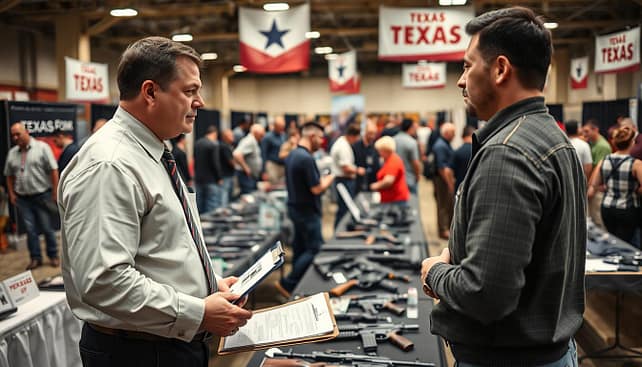
But what if you see a private seller? You can use a licensed dealer to help with the sale. This costs $20 to $30. The dealer handles the background check and paperwork.
This step is smart for both buyers and sellers. It makes the sale official. It’s like getting a receipt instead of just shaking hands.
So, how do these options compare at the gun show? Here’s a quick comparison.
| Aspect | FFL Dealer Sale | Private Party Sale (Using FFL Transfer) | Private Party Sale (Direct) |
|---|---|---|---|
| Background Check | Mandatory NICS check via dealer. | Voluntary NICS check via FFL for a fee. | Not required by federal law for private sales in Texas. |
| Primary Paperwork | ATF Form 4473 is required and retained by dealer. | ATF Form 4473 is completed for the transfer through the FFL. | Bill of sale is optional; no federal form required. |
| Legal Record | Official record of sale with the licensed dealer. | Official record of transfer with the licensed dealer. | Minimal to no formal record exists. |
| Buyer’s Assurance | Highest assurance of a lawful, documented purchase. | High assurance; adds documented layer to private sale. | Relies on seller’s discretion and verbal assurance. |
| Typical Cost Addition | Priced into the item; no separate transfer fee. | Additional fee ($20-$30) paid to the FFL for the service. | No additional fee beyond sale price. |
The smart shopper knows what to look for. The gun show schedule Texas is more than just a list of events. It helps you plan your purchases. Spotting FFL signs helps you choose wisely, balancing cost, convenience, and peace of mind.
Background Check Procedures
The debate on background checks is real, seen at Texas gun shows. Licensed dealers follow strict rules, while hobbyists have their own way. This is how Texas law works.
Buying from a Federal Firearms Licensee (FFL) means a standard process. They check you through the National Instant Criminal Background Check System (NICS). If you’re not allowed to buy, the sale stops.
But, private sellers have different rules. In Texas, they don’t need to check anyone. It’s up to you to know if you can buy. Vendors often say, “You need to know your own status.” It’s a big responsibility.
In 2017, over 170,000 sales were denied through background checks. This shows the system works. Yet, less than 1% of prison inmates got their guns at shows. This raises questions about the system’s focus.
The term “gun show loophole” is often used. Some say it’s a misnomer, as the rules are the same everywhere. It’s a choice in our laws, not a hidden rule.
| Aspect | Licensed Dealer (FFL) Sale | Private Seller Transaction |
|---|---|---|
| Background Check Requirement | Mandatory by federal law | No federal requirement in Texas |
| Who Conducts the Check | Dealer via NICS system | Not applicable; buyer self-certifies |
| Legal Basis | Brady Handgun Violence Prevention Act | Personal collection exemption |
| Typical Setting at Shows | Designated dealer tables with paperwork | Informal tables, often cash-only |
The main point is the system is simple. The debate is about the two different markets at shows.
For those who know, the real question is which path to take. This choice is made thousands of times at Texas gun shows. It’s the real story, not just the paperwork.
Private vs Dealer Sales
The key question at a firearms expo isn’t “What are you buying?” but “Who are you buying from?” This question divides the event into two worlds.
One world is the licensed dealer. They have Federal Firearms Licenses (FFLs) and follow all the rules. The other world is the private seller, who is just selling items from their own collection.
The line between these two is not clear. Texas law doesn’t set a specific number like it does for cars. Selling more than four vehicles in a year requires a dealer’s license. But selling dozens of firearms is a different story.
It all comes down to whether you’re “engaged in the business” of selling firearms. This is a vague term that depends on your intentions. Is that person with lots of guns a collector or a businessman? The law doesn’t give a clear answer.
I talked to a vendor at a show who didn’t know about any limit. He said he just sells what he doesn’t use anymore. His table had twelve guns. Was he testing the limits of the law? Probably.
This creates a unique market. The private sales are fast and based on trust. Dealer sales are slower and more about paperwork. Your choice shows your values.
| Aspect | Private Sale | Dealer Sale |
|---|---|---|
| Legal Status | Individual selling personal collection | Licensed business (FFL holder) |
| Documentation | Minimal; bill of sale optional | Form 4473, background check required |
| Transaction Speed | Often immediate | Subject to background check delay |
| Typical Cost | Usually lower (no overhead) | Includes business markup |
| Primary Advantage | Speed and simplicity | Legal certainty and record |
That table is missing a column for “risk.” That’s because you have to think about the risks yourself. Private sales offer freedom and simplicity. Dealer sales give you legal security.
This isn’t just about saving money on a gun. It’s about which America you want to support. Do you prefer the old west or modern society?
For private sales, knowing Texas law is key. The best methods for private firearm sales balance safety with practicality.
Remember, there’s no specific number of guns that makes you a dealer. The ATF looks at patterns and profit. Selling regularly or making money matters more than how many guns you sell.
At a firearms expo, you’re not just buying guns. You’re exploring different views of the Second Amendment. Each aisle shows a different take on gun rights and commerce.
The dealer side is like a bank—safe and documented. The private side is like a flea market—exciting and personal. Your choice shows your values more than your gun preferences.
Next time you’re at a show, watch who buys from whom. The choice between private and dealer sales is more than practical. It’s a way to show your values with your wallet.
Antique & Collectible Firearms
While others look at tactical gear, true collectors seek the charm of old firearms. This is more than just buying—it’s about preserving history. Each piece is a link to the past, when every gun had a story to tell.
Modern guns seem cheap compared to these treasures. Imagine holding a pre-64 Winchester Model 70, its finish telling tales of many hunts. Or a Colt Single Action Army, with its detailed engravings. A Garand rifle, with its unique *ping*, carries the weight of history in its wooden stock.
These guns start conversations, not just sales. Owners love to share their gun’s history. “This Peacemaker was with a Texas Ranger in the 1880s,” they might say. Buying one feels like adopting a piece of history.
The rules for these guns are simpler, a welcome change. Guns made before 1899 aren’t considered firearms under federal law. This means a well-preserved 1873 Winchester is treated like a vintage watch. Some antique replicas are easy to transfer, making collecting surprisingly easy.
Looking for gun show schedule Texas events changes. Seek out shows focused on collectibles or antiques. These events attract those who love history more than just guns.
What makes a gun valuable here? It’s a mix of condition, rarity, and history. A gun with honest wear is often more valuable than a perfect one. Keeping it original is key to its value.
For those who know their stuff, this section offers more than just a good deal. Holding a gun from the American frontier or World War I gives a unique perspective. When checking your gun show schedule Texas, remember: the antique section is special. It’s where a gun show becomes a temporary museum and a lesson in history.
Ammunition & Accessories
Step beyond the glass cases of gleaming firearms, and you enter the practical kingdom of the Texas gun show. Here, you find the ammunition and accessories section. It’s where budgets are tested and fantasies are accessorized.
This is where the theoretical becomes tactile. That AR-15 isn’t complete without PMAGs. Your new pistol needs a holster, a case of 9mm, and maybe a red-dot sight to feel truly yours. The sheer volume of gear is staggering—a consumerist wonderland for the well-armed.
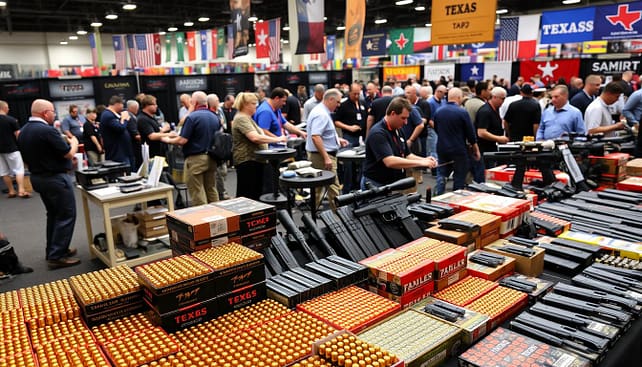
Vendors here operate on a simple, appealing premise: direct sales. Cutting out the middleman often means cutting the price. You can price out a case of ammunition or compare a dozen different optics without ever leaving the building. It’s comparative shopping with a side of gunpowder aroma.
This environment is engineered for the impulse buy. That “too good to pass up” deal on a laser sight or a bulk pack of targets has a sneaky way of inflating your total spend. The gun was the planned purchase; everything else becomes a spontaneous tribute to preparedness.
Let’s talk about the physics of it all. Ammunition is heavy. A case of 9mm isn’t a light souvenir. Factor in the schlep from the table to your vehicle—it’s the unglamorous workout of gun ownership.
The purchasing process here offers a stark contrast to buying the firearm itself. No FFL forms. No waiting periods for background checks. Buying ammo, mags, or a cleaning kit is typically as straightforward as buying a t-shirt: cash and carry. It’s commerce in its purest, simplest form.
This section of the show completes the ecosystem. It answers the “what now?” after the main acquisition. The reality of gun ownership isn’t just about possession; it’s about maintenance, supply, and customization. All those needs are met, row after row, at a bustling Texas firearms expo.
So come with a list, but expect it to evolve. The kingdom of accessories awaits, ready to equip your every tactical daydream.
Safety Demonstrations
Firearms expos are more than just buying and selling. They’re about learning and sharing knowledge.
Many people think expos are just about deals. But, there’s a lot of learning going on. Local teachers and NRA experts lead sessions. It’s a place to learn, not just shop.
Look for safety demos in the program guide. You’ll find sessions on safe handling and storage. There are talks on marksmanship for beginners. Each session teaches, shows, and supervises practice.
The “touch-only” display is very hands-on. You learn to clear firearms safely with an instructor’s help. This practice builds skills without using live ammo.
This is where the community shares its wisdom. They teach responsibility and counter chaos with order. For new buyers, these demos are priceless. They make firearms seem less scary and more manageable.
There are many types of safety demos:
| Demonstration Type | Typical Presenter | Key Skills Taught | Best For |
|---|---|---|---|
| Basic Firearm Handling | NRA Certified Instructor | Loading, unloading, clearing malfunctions | First-time owners |
| Secure Storage Solutions | Safe Company Representative | Biometric locks, quick-access safes | Families with children |
| Marksmanship Fundamentals | Competition Shooter | Stance, grip, sight alignment, trigger control | New recreational shooters |
| Maintenance & Cleaning | Gunsmith or Armorer | Disassembly, lubrication, bore cleaning | All firearm owners |
| Carry Holster Safety | Concealed Carry Instructor | Drawing, reholstering, retention techniques | CCW permit holders |
These sessions are reality checks. They teach respect for firearms. The four safety rules are repeated often. Treat every gun as if it’s loaded. Never point at anything you don’t intend to destroy. Keep your finger off the trigger until ready to shoot. Be sure of your target and what’s beyond it.
Going to a safety demo changes your view. Firearms are seen as tools, not mysterious objects. This shift is the most valuable thing you can learn at an expo.
These educational parts are a quiet rebellion. They show a community looking out for itself through knowledge. Safety is not an afterthought here. It’s the foundational creed for most attendees.
So, when you visit, don’t just look around. Check the schedule for demos. Watch how experienced people handle firearms. You’ll see the tradition of responsible ownership being passed on. That’s the real deal happening right before your eyes.
Concealed Carry Information
Walking through a Texas gun show, you notice a shift in culture. The talk turns from owning guns to carrying them. License to Carry instructors are there, ready to teach the last step.
Looking at the gun show schedule Texas for these classes is smart. They’re affordable. But getting a permit is just the start. The real lesson is about being responsible.
Instructors teach the fine details: where you can’t carry, the meaning of “30.06” signs, and how to calm situations. It’s a quick lesson in being a good citizen.
The law is always changing. In 2021, Texans could carry guns in public without a license, but a license has its perks. There are age limits and places you can’t carry. For all the details, check the official state guide. The NRA-ILA website also has important information.
This part of the show is deep. Carrying a gun is a big decision every day. It’s the quiet end of the American gun story, one holster at a time. Your next step after the gun show schedule Texas isn’t just a shooting range. It’s the real world.