
Tournament redfish don’t reward luck.
They reward discipline, timing, and repeatable patterns.
Across the Texas coast — from Sabine to South Padre — competitive redfish teams aren’t chasing oversized bull reds. They’re hunting consistent slot fish, the legal keepers that win weigh-ins by ounces, not inches. And in a format where two or three fish can define the leaderboard, strategy matters more than hero casts.
Understanding how winning teams approach Texas redfish tournaments means breaking down preparation, pattern recognition, and risk management — not just lure selection.
Understanding The Slot-Fish Objective
Most Texas redfish tournaments revolve around slot limits established by the Texas Parks & Wildlife Department, designed to protect breeding populations while maintaining competitive harvest opportunities. These regulations create a narrow size window that forces teams to prioritize precision over size alone.
Tournament success hinges on:
- Finding multiple legal fish within the slot range
- Avoiding oversized bulls that cannot be weighed
- Minimizing time spent measuring and re-culling
In contrast to fall migration strategies discussed in our guide to fall bull reds in Texas, tournament play rarely centers on giants. It centers on consistency.
The difference between a 26.00-inch fish and a 27.75-inch fish can mean disqualification. That margin forces teams to develop a filtering strategy — targeting zones statistically known for producing slot-class fish.
Pre-Fishing: Building A Pattern Before Launch Day
Winning teams rarely show up blind.
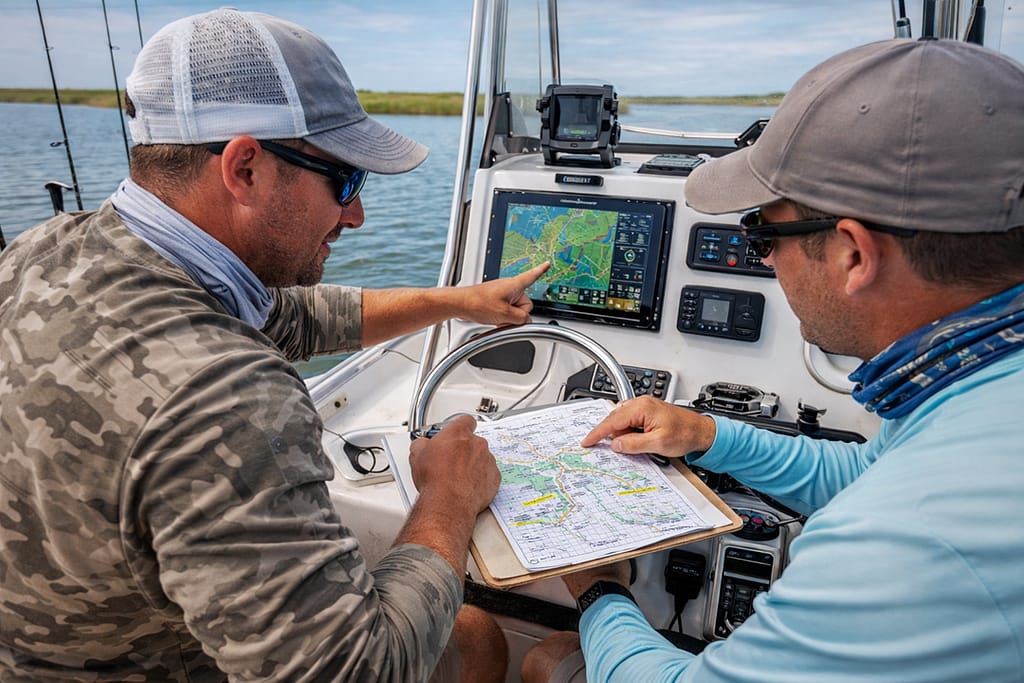
Pre-fishing often begins weeks in advance, especially for larger circuits. Instead of simply scouting fish, teams collect data:
- Tidal timing across multiple days
- Bait concentrations in specific marsh drains
- Average size trends in targeted bays
- Wind protection options if conditions shift
The goal is not to find one hot spot. It’s to identify a repeatable fishing pattern.
For example, a team may determine that outgoing mid-morning tides along wind-protected mud shorelines consistently produce 24–26-inch fish. That pattern becomes the backbone of tournament day strategy.
The most prepared teams build contingency plans — secondary locations in case boat traffic or weather disrupts primary zones.
Targeting High-Percentage Slot Zones
Not all redfish habitat produces the same average size.
Experienced tournament anglers identify areas that naturally hold mid-slot fish rather than oversized breeders or undersized juveniles.
| Habitat Type | Typical Fish Class | Tournament Value |
|---|---|---|
| Shallow Back Lakes | Mixed sizes | Requires heavy culling |
| Marsh Drains | Slot-heavy during moving tides | High efficiency |
| Oyster Shorelines | Quality mid-slot fish | Strong consistency |
| Jetty Systems | Larger bulls common | Low tournament value |
Marsh drains during moderate outgoing tides often produce some of the most reliable slot concentrations. The key is water movement without excessive flow.
Teams who understand these habitat tendencies eliminate wasted time.
Tidal Windows And Efficiency
Redfish tournaments are often decided within narrow feeding windows.
Outgoing tides concentrate bait. Incoming tides reposition fish. Slack water reduces feeding urgency.
Winning teams align their launch schedule with peak tidal movement — not sunrise.
That efficiency extends to boat positioning. Rather than drifting aimlessly, successful teams set up deliberate drifts across current seams or position up-current to allow baits to sweep naturally into strike zones.
Time management separates contenders from the middle of the pack.
Lure Selection For Consistent Results
In tournament settings, lure confidence matters more than experimentation.
Common tournament staples include:
• Paddle-tail plastics on 1/8–1/4 oz jig heads
• Gold spoons for covering shallow water
• Weedless rigged soft plastics in grass systems
• Natural-colored swimbaits during clear-water conditions
Fast-moving baits may locate fish early, but once a team identifies a productive stretch, slowing down often increases landing ratios.
Unlike recreational outings, tournaments penalize lost fish heavily. A single missed hookset can shift standings dramatically.
Communication Between Team Anglers
Redfish tournaments are typically team-based. Communication determines efficiency.
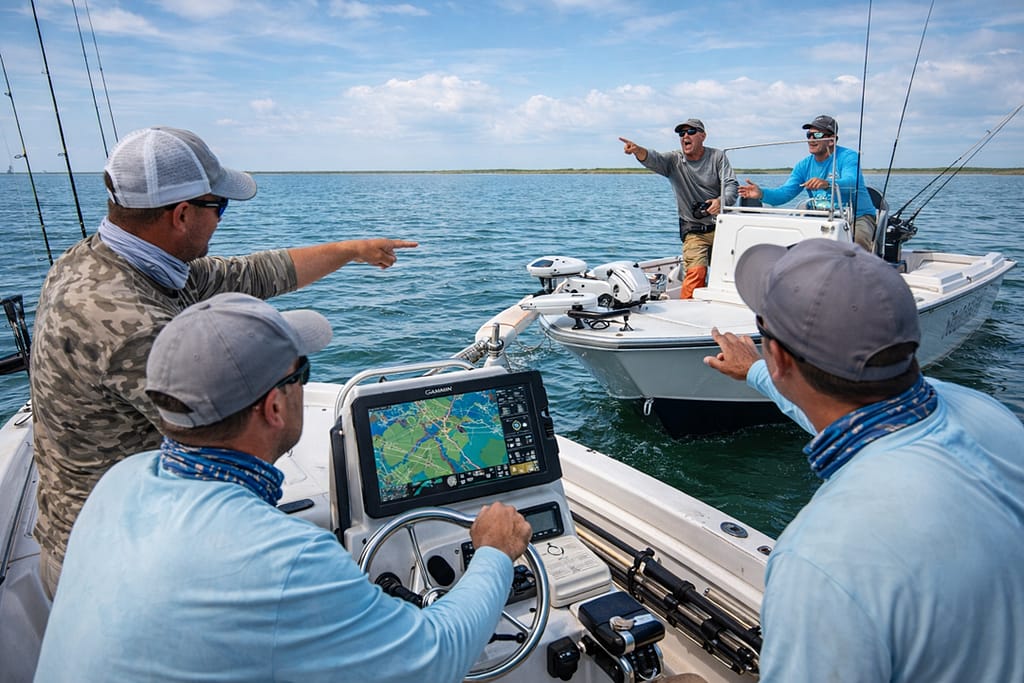
Effective teams divide responsibilities:
- One angler scans for pushes or tailing fish
- One focuses on bottom contact and structure
- One manages livewell compliance and measurements
Verbal clarity reduces confusion when fish hit simultaneously.
In larger coastal events, team performance mirrors the strategic coordination seen in other competitive fishing environments — similar to the structured discipline discussed in high-level competitive Florida freshwater fishing, where preparation and role clarity define outcomes.
The common thread across competitive environments is controlled execution under pressure.
Measuring And Culling Strategy
Slot tournaments reward accuracy.
Successful teams measure immediately upon landing a fish. Keeping a legal fish slightly below maximum slot often reduces risk compared to chasing a marginal oversized upgrade.
Culling decisions are mathematical, not emotional.
A team holding two mid-slot fish may choose consistency over chasing a risky larger fish that could exceed legal limits. Discipline prevents costly disqualifications.
Adapting When Conditions Change
No pre-fishing plan survives intact.
Wind shifts, boat congestion, or unexpected water clarity changes can disrupt established patterns. Elite teams adjust without panic.
Adaptation strategies include:
- Moving deeper after sudden cold fronts
- Shifting to wind-blown shorelines if bait relocates
- Slowing presentation during barometric pressure drops
Flexibility wins tournaments.
Why Consistency Beats Hero Fishing
Tournament redfish success is rarely about the single largest fish in the bay.
It’s about stacking reliable slot fish quickly and protecting that weight through disciplined execution.
Consistent teams:
- Avoid unnecessary long runs
- Prioritize efficiency over exploration
- Fish high-percentage water thoroughly
- Manage time aggressively
Recreational anglers often chase visual excitement. Tournament anglers chase probability.
And probability wins more often than spectacle.
Building A Winning Redfish Tournament Mindset
Texas redfish tournaments reward anglers who approach competition as a system rather than a gamble.
Preparation. Pattern recognition. Tidal alignment. Communication. Compliance.
The margin between first and fifth may be measured in ounces, but the margin between preparation and improvisation is measured in hours of planning.
Slot fish are not accidental catches.
They are targeted outcomes.
And in Texas coastal tournaments, the teams who find consistent slot fish — not occasional giants — are the ones walking across the weigh-in stage with checks in hand