
The Texas Parks and Wildlife Department’s new sea turtle stranding role should matter to every coastal angler who fishes piers, jetties, bays, surf zones, passes, marinas, and nearshore Gulf waters. On July 8, 2026, TPWD announced that, as of July 1, it had officially begun hosting the role of State Coordinator for the Texas Sea Turtle Stranding and Salvage Network. That change puts the agency at the center of statewide coordination for sea turtle strandings and incidental captures along the Texas coast. For anglers, the story is not only about wildlife rescue. It is about fishing line, boat strikes, cold-stun events, reporting habits, protected species awareness, and the responsibility that comes with sharing coastal water.
Why TPWD’s New Role Changes The Coastal Conservation Conversation
TPWD’s July 8 announcement says the agency is now hosting the State Coordinator role for the Texas Sea Turtle Stranding and Salvage Network, commonly called STSSN. As the Texas State Coordinator, TPWD will lead and facilitate statewide matters connected with sea turtle strandings and incidental captures, including inter-agency cooperation, emergency response and preparedness, and support of law enforcement.
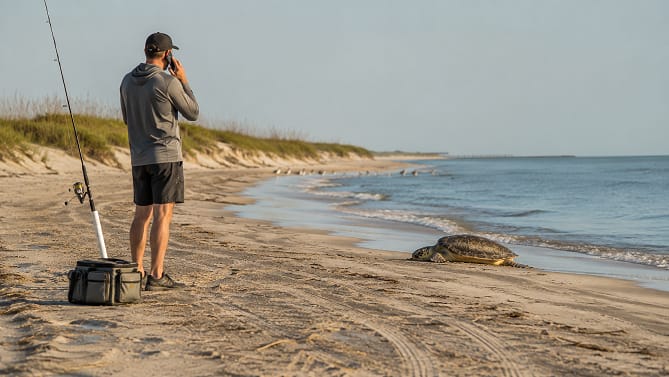
That matters because sea turtle response in Texas is not a one-organization job. It involves coastal volunteers, rehabilitation facilities, federal agencies, state officials, law enforcement, university partners, national parks, and local responders spread across hundreds of miles of coast. A stranded turtle at South Padre Island, a cold-stunned turtle in a bay system, or an entangled turtle near a fishing pier all require fast communication and clear authority.
The official TPWD release on its State Coordinator role says NOAA established the STSSN in 1980 to document sea turtle strandings from Maine to Texas and parts of the U.S. Caribbean. It also notes that the Texas network consists of partner organizations across the coast that respond to and rehabilitate stranded sea turtles.
For Texas anglers, the practical message is simple: sea turtle conservation is now more visibly tied to the same state agency that manages fishing access, coastal rules, game wardens, boating safety, and public outdoor education. That makes turtle reporting part of the broader sportsmen responsibility.
How Sea Turtle Strandings Connect Directly To Anglers
A sea turtle stranding may sound like something that happens only on remote beaches, but anglers can be among the first people to see one. Stranded turtles can appear along surf lines, jetties, bays, passes, docks, boat ramps, channels, and marsh edges. Anglers are often on the water early, late, and during weather windows when other visitors are not around.
NOAA’s Sea Turtle Stranding and Salvage Network explains that the network collects data, documents wounds and abnormalities, transports sick and injured turtles to permitted rehabilitation facilities, and educates the public about sea turtle conservation. Those details show why a simple report matters. A call from an angler can become a data point, a rescue, a rehabilitation case, or evidence of a larger coastal pattern.
Anglers also interact with sea turtle habitat in ways that matter. Fishing line can entangle turtles. Hooks can injure them. Boat traffic can strike them. Discarded bait, fish scraps, and plastic waste can worsen problems around piers and marinas. A turtle caught near fishing activity is not only a wildlife issue. It is a reminder that coastal fishing leaves a footprint.
That does not make anglers the enemy of sea turtles. It makes anglers important witnesses and partners. A responsible fishing culture can help responders find animals faster, reduce entanglement risk, and teach newer anglers what to do when protected wildlife appears.
Why Texas Has A Special Sea Turtle Responsibility
Texas is not an ordinary sea turtle state. Padre Island National Seashore’s sea turtle science program focuses on five sea turtle species found along the Texas coast: Kemp’s ridley, green, loggerhead, hawksbill, and leatherback. All five are federally listed as threatened or endangered. That means every angler who fishes the Texas coast shares water with protected wildlife.
The National Park Service’s sea turtle recovery program says Padre Island National Seashore began sea turtle conservation efforts in the 1970s and focuses on science and recovery for those five species. Kemp’s ridley is especially tied to Texas because Padre Island remains one of the most important places in the United States for the species’ recovery story.
That matters for anglers in Port Aransas, Corpus Christi, Galveston, Matagorda, South Padre Island, Rockport, Freeport, and smaller coastal communities. Turtle response is not only a beach-nesting story. It is part of the daily ecology of Texas fishing places.
Recent Texas Sportsmen coverage of Port Aransas offshore fishing culture showed how deep tournament traditions connect towns to the Gulf. TPWD’s sea turtle role adds another layer to that same coastal identity. A true fishing town is not only measured by boats and weigh-ins. It is also measured by how well it protects the marine life that shares its waters.
How Reporting Turns Anglers Into First Responders
The most important thing an angler can do around a stranded or injured sea turtle is report it quickly and avoid handling it without authorization. Padre Island National Seashore’s STSSN guidance says stranded turtles can be found year-round in bays, passes, the Gulf, or along the shoreline. It advises the public to report stranded turtles by calling 1-866-TURTLE5 and to provide the turtle’s location, size, proximity to the surf, and condition.
The National Park Service’s stranding guidance also tells people to mark the location and report whether the animal is alive or dead. That is practical information anglers can use immediately. A vague social media post is not enough. Responders need location and condition details.
For anglers, the reporting mindset should be part of the trip plan. If a turtle is entangled in line, appears weak, is floating abnormally, is stranded on the beach, or has visible injuries, the goal is not to create a video. The goal is to get trained responders there.
| What Anglers May See | Why It Matters | Better Response |
|---|---|---|
| Entangled Turtle | Line, hooks, or debris may restrict movement | Report quickly and do not attempt unsafe handling |
| Turtle On The Beach | It may be stranded, nesting, injured, or dead | Mark the location and call the hotline |
| Floating Or Weak Turtle | Could indicate illness, cold stress, injury, or exhaustion | Note location and condition for responders |
| Turtle Near A Pier Or Jetty | Fishing gear interaction may be possible | Stop casting nearby and report if distress is visible |
| Dead Turtle | Still provides important stranding data | Report location and condition |
That table belongs in every coastal angler’s mental checklist. The right response can protect the animal, the angler, and the data responders need.
Why Fishing Line And Hooks Are Part Of The Story
Texas anglers know that lost line is more than litter. Around sea turtles, it can become a direct injury risk. Monofilament, braided line, leaders, hooks, and discarded tackle can wrap flippers, necks, and shells. Entanglement can limit a turtle’s ability to swim, feed, dive, or surface.
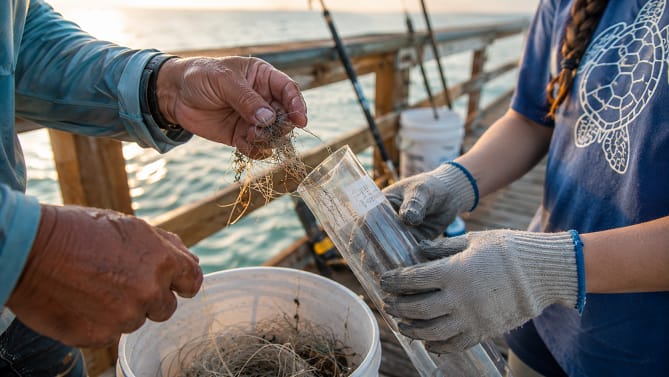
This is where everyday fishing behavior becomes conservation. Cutting loose line into the water, leaving rigs on piers, tossing bait packaging, or ignoring snagged tackle near turtle habitat can create problems long after the angler leaves. That is especially important in high-use areas such as jetties, public piers, marinas, surf zones, and passes.
Texas Sportsmen has already covered coastal data and responsibility through the Gulf-wide disCARD study, which showed why angler reporting can improve fisheries management. Turtle strandings carry a similar lesson. Reports from people on the water can reveal patterns that agencies and researchers cannot see alone.
The best anglers treat cleanup as part of the sport. They retrieve loose line when safe, pack out old rigs, use disposal tubes where available, and teach younger anglers not to leave tackle behind. Those habits may look small, but they matter when protected species share the same water.
How Cold-Stun Events Make Coordination Critical
Sea turtle response in Texas is not only about hooks or beach strandings. Cold-stun events can create large-scale emergencies when sudden cold weather leaves turtles unable to swim normally. Texas saw the scale of that problem during severe winter events, when volunteers and responders had to locate, transport, and rehabilitate large numbers of cold-stunned turtles.
The TPWD announcement specifically mentions emergency response and preparedness as part of the State Coordinator role. That language matters because major turtle events require planning before the crisis starts. Boats, vehicles, rehabilitation spaces, volunteer teams, law enforcement support, permits, and communication channels all have to work together.
For anglers, cold-stun response may seem separate from fishing season, but it is not. Many coastal anglers know bays, channels, ramps, marinas, and backwater areas better than almost anyone. They may be among the first to notice unusual turtle behavior after a cold front.
That local knowledge can help, but only if anglers report correctly and stay within legal boundaries. Sea turtles are protected, and trained personnel are the ones authorized to handle sick, injured, or dead animals. The angler’s job is to observe, mark, report, and avoid making the situation worse.
Why Incidental Capture Needs A Clear Angler Response
TPWD’s new coordination role also includes incidental captures. That phrase matters to anglers because protected wildlife can sometimes interact with fishing gear even when the angler is not targeting it. A turtle may become hooked, wrapped, or trapped near fishing activity.
A clear response is essential. Anglers should not treat an incidental capture like a normal catch. They should avoid dragging the animal, avoid cutting line too close without guidance when entanglement remains, keep people back, and contact the appropriate reporting network or authorities. If the situation involves immediate public safety, law enforcement or local officials may also need to be contacted.
The reason is simple: sea turtles are federally protected. Good intentions are not the same as legal or safe handling. A rushed rescue attempt can injure the animal, injure the angler, or make it harder for trained responders to help.
That is why TPWD’s role matters. A more visible state coordination point can help anglers understand that turtle response is part of official coastal management, not an informal volunteer guess.
How Coastal Tournaments And Clubs Can Help
Texas coastal tournaments, fishing clubs, youth programs, charter crews, and marina communities can help TPWD’s role succeed by turning turtle-response awareness into normal angler education. A tournament captain’s meeting can include a short reminder about reporting stranded or entangled sea turtles. A marina can post the hotline. A youth fishing program can teach line disposal. A pier community can remind anglers not to leave rigs behind.
That kind of education does not distract from fishing. It protects the water that makes fishing possible.
Coastal events already depend on clean launches, clear rules, conservation-minded fish handling, and community trust. Sea turtle awareness belongs in that same structure. If an offshore crew, bay tournament angler, kayak fisherman, or surf caster sees a turtle in distress, knowing what to do should be as familiar as knowing the local bag limit.
The strongest fishing communities are the ones that make responsible behavior automatic.
Why This Matters From Galveston To South Padre
Texas’ coastline is large, varied, and heavily used. Anglers fish Galveston Bay, Sabine Lake, Matagorda Bay, Aransas Bay, Corpus Christi Bay, the Laguna Madre, South Padre surf, Port Mansfield, Port Aransas jetties, Freeport waters, and many smaller access points. Sea turtle response has to cover all of that geography.
That is why statewide coordination matters. A turtle stranding near Galveston may involve different local partners than one near Padre Island, but the data and response system need to connect. NOAA’s stranding report guidance tells the public to immediately contact the local stranding network when they see a sick, injured, stranded, or dead sea turtle or marine mammal.
For anglers, that means the response should not depend on where they happen to be fishing. The habit should remain the same: observe, avoid handling, note location, report quickly, and give responders useful details.
This is especially important in coastal areas with heavy public use. A stranded turtle may be surrounded by beachgoers, boaters, tourists, anglers, and social media attention before trained responders arrive. Anglers can help by keeping distance, discouraging interference, and directing people toward the proper reporting process.
What Texas Coastal Anglers Should Do Differently Now
TPWD’s new role should push Texas coastal anglers toward a more organized safety and conservation mindset. The practical changes are not complicated.
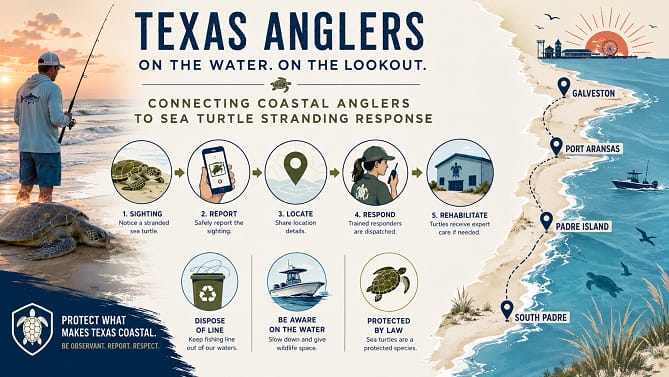
Anglers should save the 1-866-TURTLE5 number before coastal trips. They should pack out line and tackle. They should avoid casting near sea turtles. They should stop fishing if a turtle is visibly interacting with bait, line, or fish. They should report stranded, injured, entangled, or dead turtles with exact location details. They should teach children and newer anglers not to touch protected wildlife. They should let trained responders handle the animal.
Those habits fit the same responsible pattern that applies across Texas fishing. Check seasons. Know regulations. Protect habitat. Report unusual wildlife issues. Respect protected species. Leave the access point cleaner than it was found.
TPWD’s sea turtle role gives those habits a clearer statewide home.
Why Sea Turtle Response Belongs In The Texas Sportsmen Conversation
Some anglers may think sea turtle strandings are a wildlife-agency issue, not a fishing issue. That misses the point. Texas coastal anglers are among the people most likely to encounter turtles in trouble, fishing gear is one possible source of turtle injury, and marine conservation affects the same waters that support redfish, trout, flounder, snapper, tarpon, and offshore species.
TPWD’s new State Coordinator role makes the connection harder to ignore. Fishing culture and coastal conservation are not separate lanes. They meet every time an angler steps onto a pier, launches from a marina, runs through a pass, or fishes a surf line where protected wildlife may appear.
Texas’ best coastal anglers already understand that. They know the coast is not only a resource to use. It is a living system to read, respect, and protect.
TPWD’s sea turtle stranding role matters because it gives anglers a clearer way to participate in that protection. The next time a fisherman sees a stranded or entangled turtle, the right response can be as important as any cast of the day.